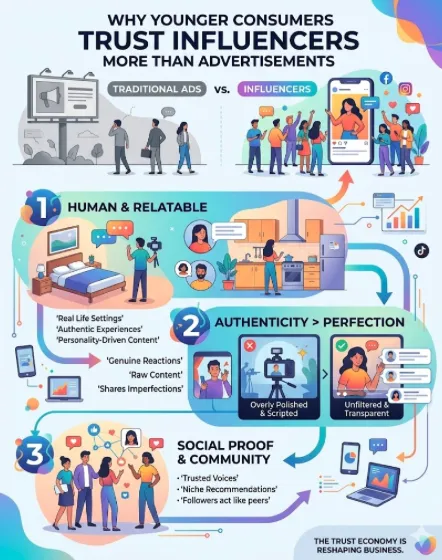
Why Younger Consumers Trust Influencers More Than Advertisements
Why Younger Consumers Trust Influencers More Than Advertisements
Traditional advertising is losing influence.
For decades, businesses relied heavily on commercials, celebrity endorsements, magazine placements, billboards, and digital ads to shape consumer behavior. The system worked because brands controlled attention. Companies decided what consumers saw, how often they saw it, and how products were presented.
That environment no longer exists.
Today’s younger consumers are growing up in a world dominated by social media, creators, personalized algorithms, and constant digital interaction. Instead of relying on companies for information, they increasingly rely on people they follow online.
In many cases, influencers now hold more purchasing power than traditional advertising campaigns.
This shift is fundamentally changing how businesses market products, build trust, and compete for consumer attention.
The rise of influencer trust is not simply a trend.
It reflects a much deeper change in consumer psychology, media consumption, and digital culture.
Younger Consumers Grew Up Distrusting Traditional Advertising
One of the biggest reasons younger generations trust influencers more than advertisements is because they were raised in an environment saturated with marketing.
Gen Z and younger millennials have spent their entire lives online.
They have grown up seeing:
YouTube ads
Instagram sponsorships
banner ads
popups
retargeting campaigns
sponsored posts
brand partnerships
algorithm-driven promotions
As a result, younger consumers have become highly skilled at identifying when companies are trying to sell to them.
Traditional advertising often feels overly polished, scripted, and emotionally disconnected.
Consumers recognize that advertisements are carefully engineered to present products in the best possible light.
That awareness creates skepticism.
Many younger consumers automatically assume advertisements are biased because they know the primary goal is persuasion.
This does not mean advertising no longer works.
But it does mean trust levels have changed dramatically.
Influencers Feel More Human
Influencers succeed because they feel more relatable than brands.
Unlike polished corporate advertisements, influencers often present products within everyday life.
They film content from:
bedrooms
cars
kitchens
apartments
gyms
vacations
normal daily environments
This creates a sense of realism and familiarity.
Followers begin viewing creators less like advertisers and more like people they know personally.
That emotional connection is incredibly powerful.
Consumers often spend hours watching influencers every week through:
TikTok
YouTube
Instagram
Twitch
podcasts
livestreams
Over time, audiences develop what psychologists call “parasocial relationships.”
These are one-sided emotional relationships where viewers feel personally connected to creators despite never meeting them.
As trust increases, recommendations begin carrying more weight.
When an influencer recommends a product, followers often interpret it as advice rather than advertising.
That difference changes purchasing behavior significantly.
Authenticity Has Become a Competitive Advantage
Modern consumers value authenticity more than perfection.
In older advertising models, companies tried to appear flawless.
Today, overly polished marketing often feels artificial.
Younger audiences prefer content that feels:
raw
casual
transparent
unfiltered
personality-driven
This is one reason influencer marketing performs so well.
Influencers frequently share:
personal opinions
real experiences
product frustrations
behind-the-scenes moments
lifestyle content
honest reactions
Even imperfections can increase trust because they make creators appear genuine.
Consumers are far more likely to trust someone who occasionally criticizes products than someone who promotes everything positively.
Ironically, being less polished often makes creators more persuasive.
This represents one of the biggest shifts in modern marketing psychology.
Authenticity now creates more engagement than perfection.
Social Proof Shapes Buying Decisions
Younger consumers are heavily influenced by social proof.
People naturally look to others when making decisions, especially in digital environments filled with endless product options.
Influencers provide social validation.
When audiences see creators using products consistently, products begin feeling:
more trustworthy
more popular
more desirable
more socially accepted
This effect becomes even stronger when influencers build communities around shared interests.
Consumers increasingly purchase products not just because they solve problems, but because they align with identity and culture.
Influencers help shape those identities.
Whether it involves:
fitness
fashion
technology
beauty
finance
entrepreneurship
gaming
travel
creators often become trusted voices within specific communities.
That targeted trust is difficult for traditional advertising to replicate.
Algorithms Favor Creator Content
Another reason influencer marketing dominates younger audiences is because social media platforms prioritize creator-driven content.
Algorithms are designed to maximize engagement.
As a result, platforms like:
TikTok
Instagram
YouTube
often push personality-based content more aggressively than traditional advertisements.
Users spend most of their time consuming creator content rather than watching direct ads.
This changes how brands reach consumers.
Instead of interrupting entertainment with advertisements, companies increasingly integrate products directly into entertainment itself.
The advertisement becomes embedded within the content experience.
This feels less disruptive and more natural to audiences.
In many cases, consumers barely perceive influencer promotions as advertisements at all.
That subtlety increases effectiveness.
Influencers Understand Niche Audiences Better Than Large Brands
Large companies often struggle to speak authentically to niche communities.
Influencers, however, typically build audiences around highly specific interests.
Some creators focus entirely on:
skincare
sneakers
luxury fashion
productivity
fitness
gaming setups
home design
cars
investing
small business advice
Because influencers deeply understand their audience, their recommendations feel more relevant and personalized.
Followers believe creators understand their preferences and lifestyle.
That relevance creates stronger trust than broad advertising campaigns designed for mass audiences.
Modern consumers increasingly prefer personalized recommendations over generalized marketing.
Influencers deliver exactly that.
Younger Consumers Value Recommendations Over Promotion
There is an important psychological difference between recommendations and advertisements.
Advertisements feel transactional.
Recommendations feel relational.
Influencers blur the line between entertainment, friendship, and product discovery.
When creators discuss products naturally during content, audiences interpret the message differently than they would a traditional ad.
For example:
A creator saying:
“I’ve genuinely been using this for months.”
feels far more persuasive than:
“Buy now for 20% off.”
Even though both messages aim to drive purchases, the emotional framing is completely different.
Younger consumers respond more strongly to perceived honesty than direct selling tactics.
Trust Now Matters More Than Reach
Traditional advertising focused heavily on mass exposure.
The goal was simple:
Reach as many people as possible.
Modern marketing works differently.
Today, trust often matters more than raw audience size.
A smaller creator with a highly engaged audience can sometimes generate better results than a massive advertising campaign.
This is because engaged communities convert more effectively than passive audiences.
Followers often view trusted influencers as experts within their niche.
That expertise creates authority.
And authority drives purchasing decisions.
Businesses increasingly recognize that influence is no longer controlled solely by corporations or celebrities.
Individual creators now hold enormous marketing power.
The Creator Economy Is Reshaping Business
The rise of influencer trust is fueling the growth of the creator economy.
Many creators are no longer simply promoting products.
They are launching:
brands
businesses
product lines
subscription communities
courses
events
Audiences trust creators enough to buy directly from them.
This represents a major shift in consumer behavior.
In many cases, consumers now trust individuals more than institutions.
That trend extends beyond products into:
news
education
entertainment
financial advice
lifestyle guidance
The relationship between audiences and creators continues becoming stronger as traditional institutional trust declines.
Businesses Must Adapt to the Trust Economy
The rise of influencer marketing reveals something much larger happening in business.
Modern consumers are increasingly choosing trust over corporate messaging.
That means businesses can no longer rely solely on polished advertisements to build brand loyalty.
Today’s consumers want:
authenticity
transparency
relatability
personality
community
human connection
Brands that feel overly corporate or emotionally disconnected often struggle to connect with younger audiences.
Meanwhile, brands that collaborate naturally with creators often gain stronger engagement and credibility.
The companies winning in 2026 are frequently the ones that understand how to build relationships rather than simply broadcast advertisements.
Final Thoughts
Younger consumers trust influencers more than advertisements because influencers feel human.
They feel relatable, authentic, transparent, and emotionally accessible in ways traditional advertising often does not.
This shift is not simply about social media trends.
It reflects a larger transformation in how trust is built in the digital age.
Consumers no longer want to feel marketed to constantly.
They want recommendations from people they believe understand them.
That is why influencer marketing has become one of the most powerful forces in modern business.
The brands that understand this shift, and learn how to build authentic trust rather than simply buy attention, will have a major advantage in the years ahead.
