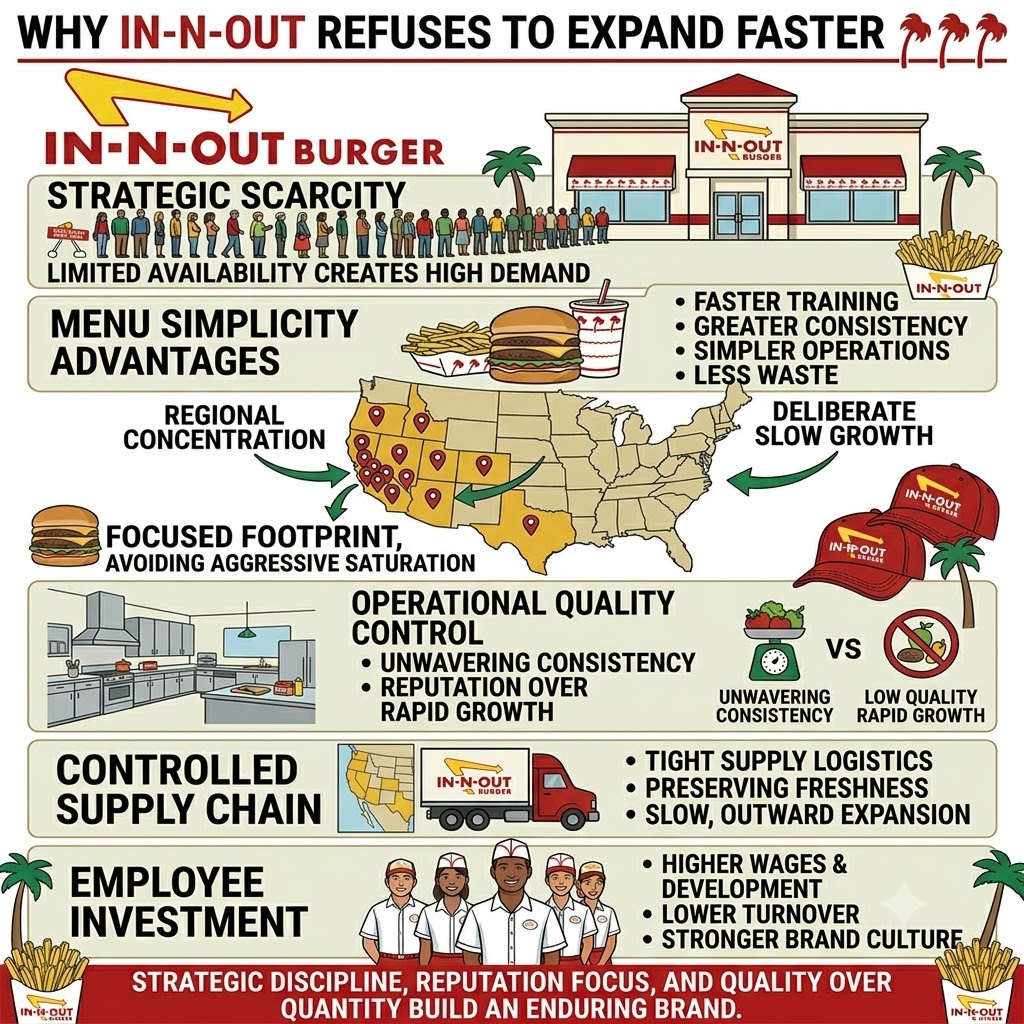
Why In-N-Out Refuses to Expand Faster
Why In-N-Out Refuses to Expand Faster
In today's business world, growth is often treated as the ultimate measure of success.
Investors want growth. Executives want growth. Competitors chase growth. Companies are constantly looking for ways to expand into new markets, increase revenue, and capture larger shares of their industries.
For most restaurant chains, the playbook is simple. Open more locations, enter new markets, add new products, and scale as quickly as possible.
Yet one of America's most successful restaurant brands has spent decades doing almost the exact opposite.
Despite having one of the most loyal customer bases in the country and demand that extends far beyond its current footprint, In-N-Out Burger continues to expand at a remarkably slow pace.
The company has resisted the temptation to rapidly franchise, launch nationwide expansion plans, or pursue aggressive growth strategies. Instead, it has focused on something far less exciting to Wall Street but incredibly valuable to customers: consistency.
To many observers, the strategy seems strange.
Why would a company with such a strong reputation intentionally limit its growth?
The answer lies in three powerful business principles:
Scarcity.
Quality control.
Supply chain advantages.
Together, these factors have helped In-N-Out build one of the strongest restaurant brands in America while avoiding many of the challenges that have hurt competitors during periods of rapid expansion.
The Modern Obsession With Growth
Most companies operate under the assumption that bigger is always better.
When a business becomes successful in one market, the natural next step is often expansion. Investors and executives see untapped demand as an opportunity that must be captured as quickly as possible.
The restaurant industry is filled with examples.
Brands that find early success often race to open hundreds of locations nationwide. Franchising agreements accelerate growth. Menus expand. New products are introduced. Expansion becomes the primary objective.
Sometimes it works.
Other times, growth creates problems.
As businesses expand, maintaining quality becomes more difficult. Supply chains become more complex. Employee training becomes harder. Customer experiences become less consistent.
The very factors that made the business successful can become diluted.
In-N-Out recognized this risk decades ago.
Instead of treating growth as the goal, the company treats growth as something that must be earned.
Every new location must support the same customer experience that built the brand in the first place.
If that means opening fewer restaurants, so be it.
Scarcity Creates Stronger Demand
One of the most powerful concepts in business and consumer psychology is scarcity.
People tend to value things more when access is limited.
Luxury brands understand this.
Limited-edition products understand this.
Exclusive memberships understand this.
In-N-Out benefits from scarcity in a way that few restaurant chains can replicate.
Because the company operates in a relatively small number of states, visiting an In-N-Out often feels like an experience rather than a routine purchase.
For many travelers, eating at In-N-Out becomes part of the trip itself.
People who move away from California frequently talk about missing the brand. Visitors often make special stops to experience it. Social media is filled with tourists documenting their first visit.
This type of consumer behavior is difficult to manufacture.
Many companies spend millions trying to create exclusivity and excitement around their products.
In-N-Out achieves much of it naturally through limited availability.
The brand has become culturally significant partly because it isn't everywhere.
Consumers often perceive the restaurant as special because access remains relatively limited.
Had the company rapidly expanded nationwide years ago, some of that appeal might have disappeared.
Scarcity creates anticipation.
Anticipation creates demand.
Demand strengthens brand value.
The Danger of Expanding Too Quickly
History is filled with examples of restaurant brands that expanded faster than they could effectively manage.
Rapid growth often creates operational challenges that customers notice immediately.
A location opens before management systems are fully developed.
Supply chains become stretched.
Employee training becomes inconsistent.
Food quality begins to vary.
Customer experiences become unpredictable.
Once consistency declines, reputation often follows.
Consumers rarely care why quality changed.
They simply notice that the experience isn't as good as it used to be.
This is particularly dangerous in today's review-driven economy.
A single negative experience can quickly become a public review, social media post, or online complaint.
Reputation can be damaged faster than ever before.
In-N-Out's leadership has consistently prioritized avoiding these risks.
Rather than opening locations based solely on market demand, the company focuses on whether it can maintain operational excellence.
That philosophy often means saying no to opportunities that would excite other businesses.
Quality Control Is the Foundation of the Brand
Ask loyal customers why they love In-N-Out and the answer is usually surprisingly simple.
Consistency.
Customers know what to expect.
Whether someone visits a location in California, Arizona, Nevada, Texas, Utah, Colorado, Idaho, or Oregon, the experience feels remarkably similar.
The menu remains familiar.
The service standards remain consistent.
The food quality remains reliable.
That level of consistency is extremely difficult to achieve at scale.
Every additional location introduces new variables.
New managers.
New employees.
New suppliers.
New operational challenges.
Many companies accept some decline in consistency as the cost of growth.
In-N-Out does not.
The company has built its reputation around delivering the same experience every time.
Protecting that reputation requires discipline.
It also requires patience.
By expanding slowly, the company can devote more attention to training, operations, and quality assurance.
This helps maintain the standards customers have come to expect.
A Small Menu Creates Big Advantages
One of In-N-Out's most underrated business decisions is its menu.
Compared to competitors, the menu is remarkably simple.
While other chains introduce seasonal offerings, limited-time promotions, specialty sandwiches, and constantly evolving product lines, In-N-Out largely focuses on a small number of core items.
At first glance, this may appear limiting.
In reality, it creates enormous operational advantages.
A smaller menu means:
• Faster employee training
• Better inventory management
• Greater consistency
• Less waste
• Simpler operations
• Faster service
Every item can receive more attention because there are fewer products to manage.
Employees become experts rather than generalists.
Customers know exactly what the brand represents.
The menu supports the company's broader strategy of maintaining quality while scaling carefully.
Supply Chain Control Is a Competitive Advantage
One of the biggest reasons In-N-Out limits expansion involves something customers rarely see:
The supply chain.
Every restaurant depends on a network of suppliers, distribution systems, transportation routes, and operational logistics.
As businesses expand geographically, those systems become increasingly complex.
Many chains solve this challenge by accepting longer supply chains and more distribution layers.
In-N-Out takes a different approach.
The company is known for maintaining tight control over sourcing and distribution.
Freshness remains a core part of its brand identity.
Maintaining that standard becomes more difficult as locations move farther away from distribution centers.
This is one reason expansion often follows a geographic pattern.
New restaurants are typically opened within reasonable distance of existing supply infrastructure.
Rather than stretching operations across the country, the company expands outward methodically.
This allows leadership to preserve food quality while minimizing logistical risks.
The result is a supply chain that supports consistency instead of compromising it.
Employee Investment Supports Long-Term Success
Another factor that separates In-N-Out from many competitors is its investment in employees.
The company has long been recognized for offering wages and advancement opportunities that exceed industry norms.
This approach creates several benefits.
Higher employee satisfaction.
Lower turnover.
Better customer service.
Stronger operational consistency.
When employees stay longer, institutional knowledge grows.
Training becomes more effective.
Management pipelines become stronger.
Customer experiences improve.
Rapid expansion often strains hiring and training systems.
Businesses are forced to fill positions quickly, sometimes sacrificing quality in the process.
By growing more gradually, In-N-Out can maintain its standards while continuing to develop talent internally.
Reputation Becomes the Ultimate Competitive Advantage
In today's digital economy, reputation has become one of the most valuable business assets.
Consumers rely on reviews, ratings, recommendations, and social proof before making decisions.
A strong reputation influences:
• Customer acquisition
• Customer loyalty
• Brand trust
• Pricing power
• Long-term growth
In-N-Out's slow-growth strategy has helped protect one of its most valuable assets: customer trust.
Customers trust that the experience will be consistent.
They trust the quality.
They trust the brand.
That trust has been built over decades and reinforced through disciplined decision-making.
While competitors chase market share, In-N-Out continues strengthening its reputation.
Over time, that reputation becomes a significant competitive advantage.
The Business Lesson Most Companies Miss
The biggest takeaway from In-N-Out's strategy is not that businesses should avoid growth.
It's that growth should support quality, not replace it.
Many companies treat expansion as the objective.
In-N-Out treats customer experience as the objective.
Growth happens only when it can support that experience.
This distinction matters.
Businesses that expand too quickly often discover that scaling problems eventually become customer problems.
Businesses that prioritize quality create stronger foundations for long-term success.
Growth becomes more sustainable because it is built on consistency rather than momentum alone.
Final Thoughts
In-N-Out's refusal to expand faster isn't a sign of caution.
It's a strategic decision rooted in understanding what made the brand successful in the first place.
Scarcity keeps demand high.
Quality control protects customer trust.
Supply chain discipline preserves consistency.
Together, these factors have helped transform a regional burger chain into one of the most respected brands in the restaurant industry.
In a world where many companies chase growth at all costs, In-N-Out offers a different lesson.
Sometimes the smartest way to grow is not to grow as fast as possible.
Sometimes the smartest way to grow is to protect what made customers love you in the first place.
That philosophy may not generate headlines every quarter, but it has helped create something far more valuable:
A brand customers trust, recommend, and remain loyal to year after year.
