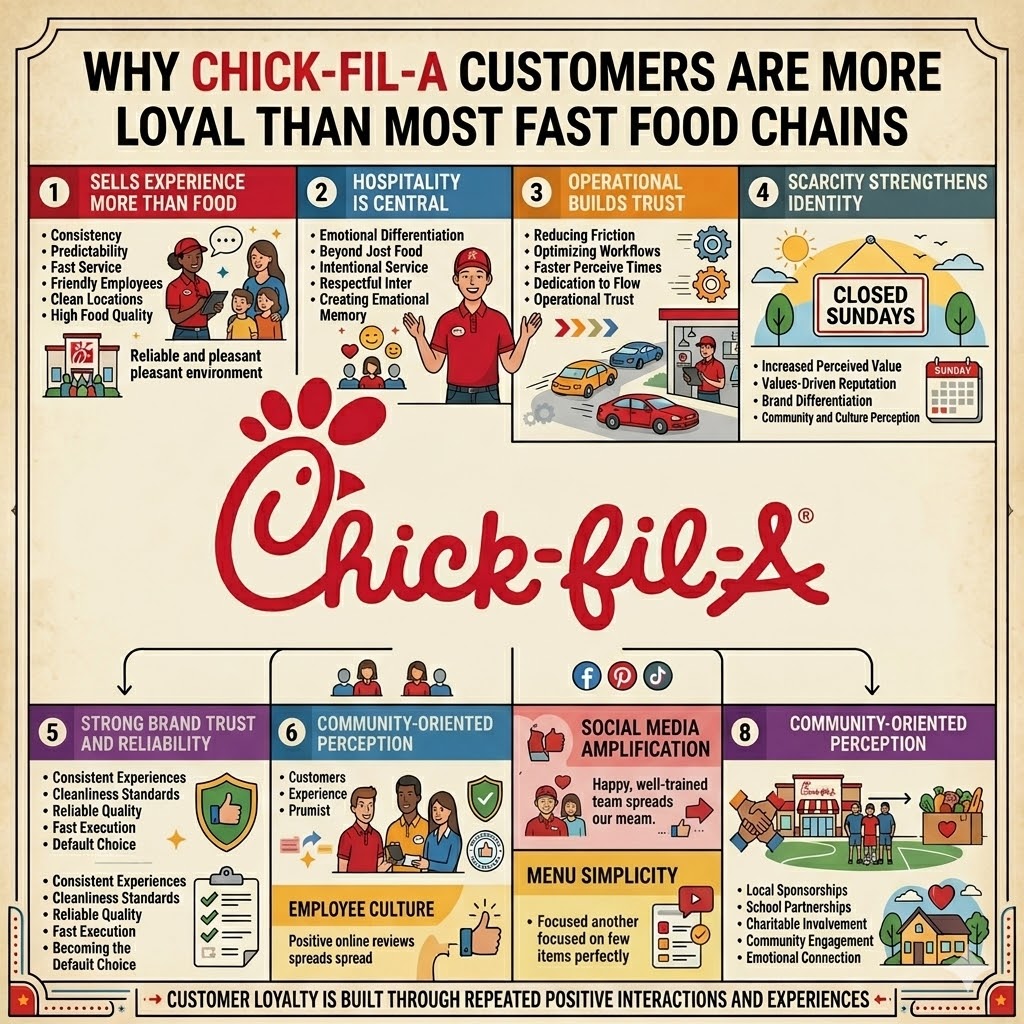
Why Chick-fil-A Customers Are More Loyal Than Most Fast Food Chains
Why Chick-fil-A Customers Are More Loyal Than Most Fast Food Chains
Introduction
In one of the most competitive industries in the world, very few restaurant brands have built the level of customer loyalty that Chick-fil-A has achieved.
Fast food is traditionally driven by convenience, pricing, speed, and location density. Most chains compete aggressively through discounts, promotions, advertising campaigns, and menu expansion in an effort to attract repeat customers.
But Chick-fil-A operates differently.
Despite being closed every Sunday, maintaining a smaller store footprint than many competitors, and often having higher prices than other fast food chains, Chick-fil-A consistently generates some of the highest customer satisfaction and sales-per-location numbers in the restaurant industry.
The company has transformed what is typically viewed as a transactional industry into an experience-driven brand built around consistency, hospitality, trust, and emotional connection.
And that difference matters.
Because modern consumers are no longer loyal simply because a product is cheap or convenient. Increasingly, they remain loyal to businesses that create reliable experiences and strong emotional associations.
Chick-fil-A understood this shift earlier than most fast food companies.
The result is one of the strongest customer loyalty ecosystems in modern restaurant history.
Chick-fil-A Sells Experience More Than Food
One of the biggest reasons Chick-fil-A customers remain loyal is because the company sells more than chicken sandwiches.
It sells predictability.
Consumers know almost exactly what to expect every time they visit:
Fast service
Friendly employees
Clean locations
Consistent food quality
Professional interactions
Operational efficiency
In the restaurant industry, consistency is one of the hardest things to scale.
Many fast food brands struggle with location-to-location quality variation. One store may deliver excellent service while another creates a frustrating customer experience.
Chick-fil-A has spent decades building systems focused heavily on operational consistency.
For customers, this creates trust.
People are more likely to return to businesses when they feel confident the experience will reliably meet expectations.
That confidence becomes a major driver of loyalty over time.
Hospitality Is Central to the Brand
Most fast food chains compete primarily on speed and price.
Chick-fil-A competes heavily on hospitality.
The brand intentionally positions customer service as part of its identity rather than simply an operational requirement.
Simple phrases like:
“My pleasure.”
Have become strongly associated with the brand itself.
This may seem minor on the surface, but psychologically, repeated positive interactions create emotional memory.
Customers remember how businesses make them feel.
In an industry often associated with rushed interactions and inconsistent service, Chick-fil-A stands out because the experience feels more personal and intentional.
Employees are trained to maintain professionalism, eye contact, attentiveness, and polite communication at a level uncommon in traditional fast food environments.
Over time, this creates emotional differentiation.
Consumers begin associating the brand with reliability, comfort, and positive treatment rather than just food.
That emotional connection strengthens loyalty significantly.
Operational Efficiency Builds Consumer Trust
One of the most impressive aspects of Chick-fil-A’s business model is its operational execution.
Drive-thru lines at Chick-fil-A locations are often visibly longer than competitors, yet customers frequently perceive the experience as faster and smoother.
This is because the company heavily prioritizes operational flow.
Many locations use:
Multiple outdoor employees taking orders
Tablet-based ordering systems
Highly optimized kitchen workflows
Dedicated traffic management systems
Simplified menu operations
Consumers value efficiency far more than businesses sometimes realize.
Fast food customers are often making convenience-based decisions during busy routines, work breaks, commuting hours, or family schedules.
When a restaurant consistently reduces friction, customers reward it with repeat visits.
Operational reliability creates habit formation.
And habits create loyalty.
Scarcity Strengthens Brand Identity
One of the most unique aspects of Chick-fil-A’s business strategy is remaining closed on Sundays.
From a pure revenue perspective, many analysts have argued the company sacrifices billions in potential sales by closing one day every week.
But strategically, the policy has helped strengthen the brand identity.
Scarcity often increases perceived value.
Consumers psychologically assign greater significance to businesses that appear disciplined, selective, or values-driven.
The Sunday closure policy also reinforces Chick-fil-A’s image as a company with a defined culture rather than simply another fast food corporation focused exclusively on maximizing revenue.
Whether consumers personally agree with the reasoning or not, the policy contributes to the perception that the company operates differently from competitors.
And differentiation is powerful in crowded industries.
Chick-fil-A Benefits From Strong Brand Trust
Modern consumers increasingly care about trust and reliability when choosing businesses.
This is especially important in industries where consumers have endless alternatives.
Fast food customers can easily switch between brands within minutes.
Because of this, trust becomes a major competitive advantage.
Chick-fil-A has spent years building trust through:
Consistent customer experiences
Strong cleanliness standards
Reliable food quality
Fast service execution
Professional communication
Predictable operational systems
When consumers repeatedly experience positive outcomes, confidence increases.
Eventually, many customers stop evaluating alternatives entirely.
The brand becomes the default choice.
This is one of the strongest forms of customer loyalty any business can achieve.
The Brand Creates Community-Oriented Perception
Another reason Chick-fil-A maintains strong customer loyalty is its community-focused branding.
Many locations participate heavily in:
Local sponsorships
School partnerships
Community events
Charitable involvement
Fundraising programs
This creates localized emotional attachment.
Consumers are more likely to support businesses they perceive as active contributors within their communities.
Large corporations often struggle to feel personal or community-oriented.
Chick-fil-A locations frequently feel more locally connected despite operating within a national franchise system.
This perception strengthens consumer affinity and repeat engagement.
Employee Culture Impacts Customer Experience
Customer loyalty is often directly connected to employee experience.
Businesses with poor internal culture frequently struggle to maintain strong customer satisfaction long-term.
Chick-fil-A places heavy emphasis on employee structure, training, and workplace standards.
While no large company is perfect, the brand has built a reputation for maintaining stronger employee engagement and operational accountability than many competitors.
Employees who feel supported and trained properly are more likely to:
Communicate positively
Handle problems professionally
Maintain consistency
Deliver stronger service experiences
Consumers notice these differences immediately.
And because customer interactions happen publicly, employee culture becomes part of brand perception itself.
Social Media Amplifies Positive Reputation
In today’s digital economy, customer experiences spread faster than ever.
Social media platforms have amplified Chick-fil-A’s reputation significantly.
Consumers regularly post about:
Fast drive-thru service
Friendly interactions
Employee kindness
Clean stores
Accurate orders
Positive experiences
This creates continuous organic marketing.
Modern consumers trust peer experiences far more than advertisements.
Every positive customer interaction shared online reinforces the brand’s reputation publicly.
This creates a powerful reputation loop:
Positive experience → online sharing → stronger reputation → more customers → more positive experiences.
Brands with strong reputational momentum often outperform competitors without needing to rely solely on aggressive advertising.
Simplicity Helps Operational Excellence
Many fast food chains continuously expand menus in an effort to capture more consumer demand.
But overly large menus often create operational complexity.
Chick-fil-A has remained relatively disciplined compared to competitors.
Its menu is focused, recognizable, and operationally manageable.
This simplicity helps the company maintain:
Faster preparation times
Better quality consistency
Easier employee training
Stronger operational execution
Consumers often associate simplicity with confidence.
Rather than trying to offer everything, Chick-fil-A focuses heavily on executing a narrower experience exceptionally well.
That focus contributes heavily to customer satisfaction.
Loyalty Is Built Through Repetition
Customer loyalty rarely happens instantly.
It compounds over time through repeated positive interactions.
Chick-fil-A succeeds because it consistently delivers experiences that reduce uncertainty for consumers.
Customers know:
The food will likely meet expectations
The service will likely feel professional
The process will likely feel efficient
The environment will likely feel clean and organized
That consistency lowers decision fatigue.
And businesses that reduce friction often become default consumer choices.
Eventually, loyalty becomes habitual.
Why Chick-fil-A Outperforms Many Competitors
Many fast food brands focus heavily on:
Price competition
Limited-time promotions
Celebrity campaigns
Viral marketing
Menu expansion
Chick-fil-A focuses heavily on operational trust.
That difference matters.
Because while advertising can generate temporary attention, customer loyalty is usually built through experience quality over time.
Consumers may try a restaurant because of marketing.
But they return because of consistency.
Final Thoughts
Chick-fil-A’s success is not simply about chicken sandwiches.
It is about trust, consistency, hospitality, operational excellence, and emotional reliability.
The company has built one of the strongest loyalty systems in the restaurant industry by understanding something many businesses overlook:
Customers remember experiences more than advertisements.
In a world where consumers have endless options, businesses that consistently create positive experiences gain a massive long-term advantage.
And that is exactly what Chick-fil-A has done.
