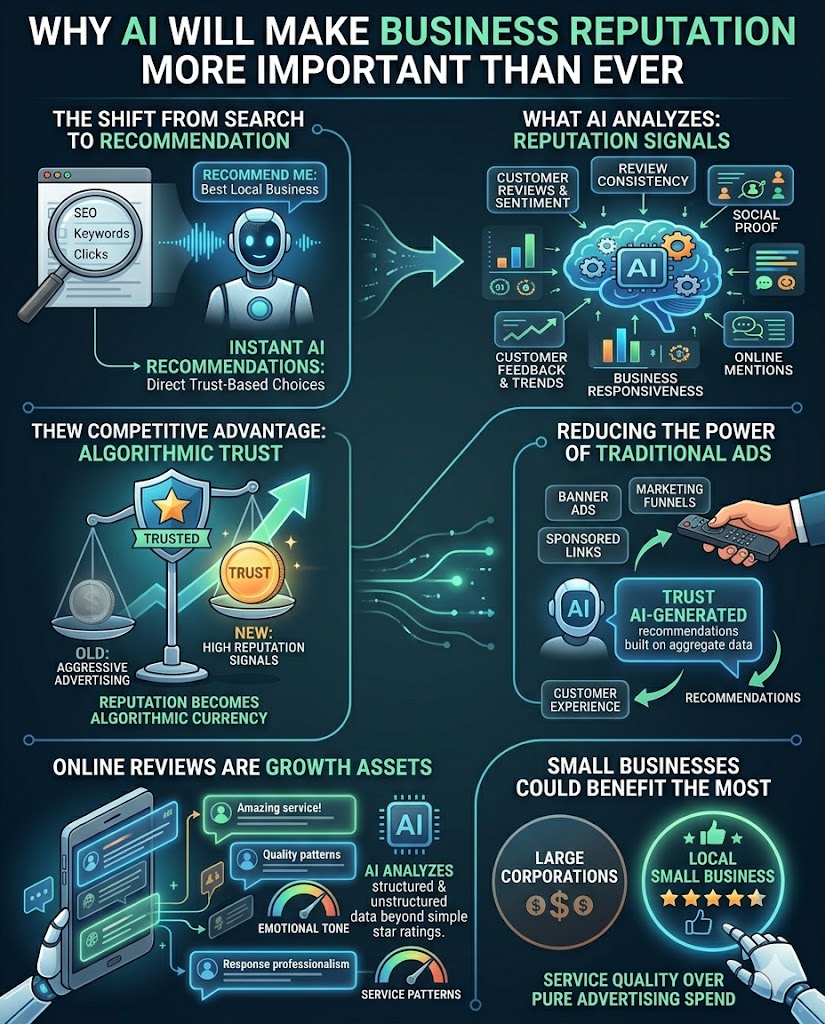
Why AI Will Make Business Reputation More Important Than Ever
Why Restaurants Are Becoming Media Companies
For years, restaurants competed primarily on food quality, location, and service.
Today, that is no longer enough.
Modern restaurants are increasingly competing for something much bigger than foot traffic:
attention.
In today’s digital economy, some of the fastest-growing restaurants are not simply food businesses anymore. They are becoming full-scale media brands.
From viral TikTok videos and cinematic food photography to creator collaborations, branded merchandise, and personality-driven social media accounts, restaurants are evolving far beyond the traditional dining model.
And the businesses adapting fastest are often the ones growing fastest.
The Rise of Attention-Based Dining
Consumer behavior has fundamentally changed.
Before choosing where to eat, customers now often check:
TikTok videos
Instagram Reels
Google reviews
Food influencers
Social media comments
Aesthetic interiors
Viral menu items
Restaurants no longer compete only on taste.
They compete on visibility and shareability.
A restaurant can serve incredible food, but if nobody talks about it online, growth becomes significantly harder in today’s market.
Meanwhile, restaurants with strong online presence often generate enormous demand before customers even walk through the door.
Attention itself has become a business asset.
Social Media Changed Restaurant Economics
Platforms likeTikTokandInstagramdramatically changed how restaurants grow.
Years ago, word-of-mouth spread slowly through local communities.
Now, one viral video can bring thousands of customers within days.
A single creator review can:
Sell out menu items
Create hour-long lines
Increase reservations overnight
Turn local restaurants into tourist destinations
This has created an entirely new form of restaurant marketing:
organic digital distribution.
Restaurants that understand content now have a major competitive advantage.
The Best Restaurants Build Brand Identity
Many successful restaurants today feel instantly recognizable online.
Consumers increasingly remember restaurants for:
Their aesthetic
Their tone of voice
Their presentation style
Their interior design
Their personality online
Their storytelling
In many ways, restaurants now operate similarly to lifestyle brands.
Some businesses intentionally design interiors to encourage customer photos and social sharing. Others build signature menu items specifically engineered for online visibility.
The food still matters.
But the experience surrounding the food matters more than ever before.
Customers Want Shareable Experiences
Modern consumers increasingly choose restaurants based on experiences rather than pure convenience.
People want:
Visually appealing environments
Unique menu items
Interactive dining moments
Story-driven brands
“Instagrammable” presentation
Experiences worth sharing online
As a result, restaurants are investing more heavily into:
Interior aesthetics
Branding
Packaging
Lighting
Social media content
Video production
Dining has become partially entertainment-driven.
And restaurants capable of combining strong food with strong storytelling often dominate online attention.
Restaurants Are Building Communities
The strongest restaurant brands today do more than sell meals.
They build communities.
Many restaurants now maintain active audiences through:
Daily social content
Behind-the-scenes videos
Founder storytelling
Staff personalities
Customer interaction
Community events
This creates emotional connection with customers long before they place an order.
Consumers increasingly support businesses they feel connected to personally.
That emotional familiarity builds stronger loyalty and stronger repeat business.
Media Creates Compounding Growth
Traditional advertising usually stops working once spending stops.
Content works differently.
A single viral TikTok or Instagram Reel can continue generating:
Views
Shares
Search traffic
Reservations
Brand awareness
Customer trust
for weeks or even months after posting.
This creates compounding visibility.
Restaurants with strong content ecosystems often reduce their dependence on traditional advertising entirely because customers begin promoting the business organically.
That type of attention becomes extremely valuable.
Smaller Restaurants Can Now Compete
One of the biggest shifts created by social media is accessibility.
Years ago, large restaurant groups dominated visibility through massive advertising budgets.
Today, a small local restaurant can compete nationally through content alone.
A family-owned café with:
Great branding
Strong visuals
Viral menu items
Authentic storytelling
can outperform much larger competitors online.
This has leveled the playing field in ways the restaurant industry has never seen before.
Reputation and Media Now Work Together
Restaurant growth today increasingly comes from the combination of:
Reputation
Content
Visibility
Customer experience
Strong experiences generate positive reviews and social sharing.
That sharing generates attention.
Attention brings new customers.
And new customers create more content and reputation signals.
The businesses winning today understand this cycle extremely well.
Why This Trend Will Continue Growing
As recommendation algorithms, AI-driven discovery, and creator culture continue evolving, restaurants will likely become even more media-focused.
Consumers increasingly discover restaurants through:
TikTok algorithms
Instagram Reels
YouTube Shorts
Food creators
Community recommendations
rather than traditional advertising.
Restaurants that fail to adapt to this attention economy may struggle to maintain visibility in increasingly crowded markets.
Meanwhile, restaurants capable of consistently creating both strong experiences and strong content will continue building outsized growth.
Final Thoughts
The modern restaurant industry is no longer just about food.
It is about attention, storytelling, reputation, and experience.
The restaurants growing fastest today often understand that they are not simply operating kitchens anymore.
They are building media brands.
Because in today’s economy, visibility drives discovery.
And discovery drives growth.
