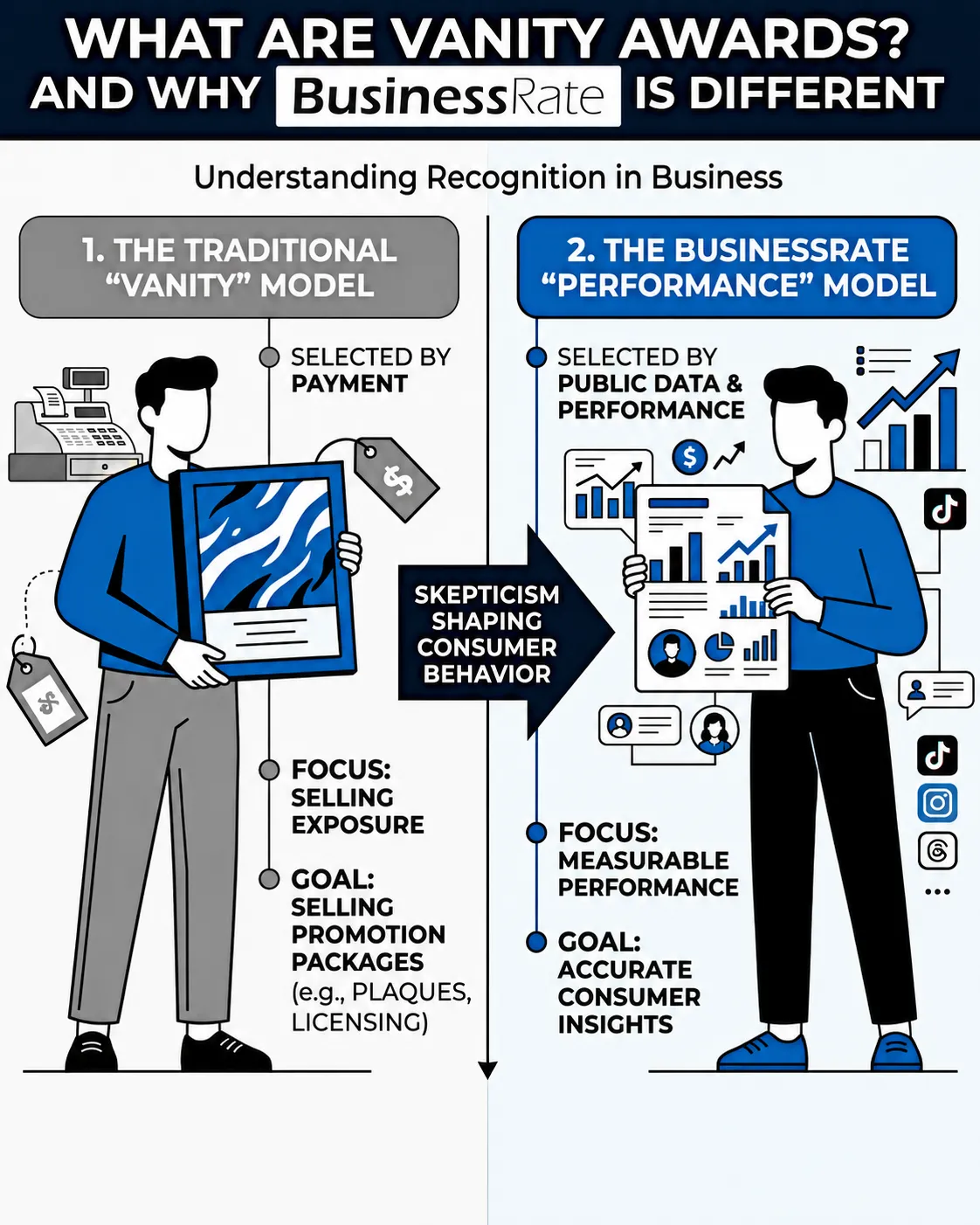
What Are Vanity Awards? And Why BusinessRate Is Different
What Are Vanity Awards? And Why BusinessRate Is Different
Introduction
Business awards are everywhere.
Every week, companies across the country receive emails, letters, or advertisements claiming they were selected as a “Top Business,” an “Industry Leader,” or a “Best Of” winner.
At first glance, these recognitions can appear impressive.
They often use polished branding, official sounding language, and phrases designed to create credibility and prestige.
But over the last several years, consumers and business owners have become increasingly skeptical of certain types of recognition programs.
Why?
Because not all awards operate the same way.
Some recognition systems are built around measurable performance and public data.
Others are built primarily around selling exposure, promotional packages, licensing rights, plaques, or marketing materials.
This is where the term “vanity award” comes from.
Today, businesses are asking more questions than ever before:
Is this recognition legitimate?
Can companies pay for placement?
What standards are actually being used?
Is there real data behind the ranking?
Is the award earned or marketed?
Those questions matter.
Modern consumers rely heavily on trust signals when making decisions online. Reviews, ratings, rankings, and public reputation now shape everything from where people eat to which companies they hire.
Because of that, transparency has become extremely important.
At BusinessRate, we believe businesses deserve clear and measurable reputation insights built on real customer feedback and public review data.
That is also why we believe it is important to explain the difference between vanity awards and data driven reputation systems.
What Is A Vanity Award?
A vanity award is typically a recognition program where the business model revolves around selling recognition and promotional visibility to recipients.
In many cases, businesses are informed that they have been “selected” or “recognized” for an award.
Afterward, they are encouraged to purchase things like:
Plaques
Trophies
Award badges
Licensing rights
Marketing materials
Press releases
Featured listings
Promotional packages
Advertising placements
The recognition itself often becomes part of a larger sales funnel.
The award creates perceived prestige, and the organization profits from businesses wanting to display that recognition publicly.
This is why these programs are commonly referred to as vanity awards.
The focus is often centered more on the appearance of authority than on measurable independent performance.
That does not necessarily mean every award program is fraudulent.
Some are selective and legitimate.
However, skepticism increases when:
Selection criteria are unclear
Large numbers of businesses receive awards
Recognition appears easy to obtain
Transparency is limited
Businesses can effectively pay for visibility
Consumers cannot verify how winners were chosen
Over time, these patterns have made consumers more cautious about business awards and recognition labels.
Why Vanity Awards Became Popular
Recognition influences consumer psychology.
People naturally trust businesses that appear validated by third parties.
Awards can instantly create:
Social proof
Authority
Credibility
Consumer confidence
Competitive differentiation
In digital environments where consumers make quick decisions, these visual trust signals can strongly influence perception.
Businesses understand this.
That is why companies often display:
Award logos
“Best Of” badges
Certification seals
Recognition graphics
Industry rankings
The problem is that consumers increasingly want to know whether those signals are actually meaningful.
Today’s consumers are much more aware of marketing tactics than previous generations.
Younger audiences especially tend to question anything that feels overly promotional or artificially inflated.
That skepticism has created a major shift in how trust is built online.
The Shift Toward Data Driven Trust
Over the last decade, online reviews have fundamentally changed business reputation.
Consumers now rely heavily on:
Google reviews
Public ratings
Customer feedback
Social proof
Community recommendations
Reputation trends
People increasingly trust measurable public feedback more than polished marketing claims.
This shift has created demand for systems that evaluate businesses using real customer data rather than vague promotional language.
That is where reputation intelligence platforms entered the market.
Instead of relying on subjective opinions or internal judging panels, modern reputation systems increasingly analyze:
Review volume
Review consistency
Rating trends
Customer sentiment
Comparative industry performance
Public feedback patterns
The goal is to create measurable transparency.
Consumers want evidence.
Businesses want benchmarks.
And both sides increasingly value data over symbolism.
Why BusinessRate Was Created
BusinessRate was created because we saw how important online reputation had become for modern businesses.
Today, consumers research businesses constantly before making decisions.
They compare:
Ratings
Reviews
Customer experiences
Reputation trends
Public credibility
Search visibility
A business’s reputation now directly impacts:
Customer trust
Conversion rates
Consumer confidence
Local visibility
Long term growth
We built BusinessRate around the idea that reputation should be measurable through real customer feedback.
Not through subjective prestige.
Not through vague marketing claims.
And not through paid symbolic recognition.
At the center of the platform is the BusinessRate Score.
This is a 0 to 300 reputation scoring system built using verified Google review data and comparative performance analysis.
The score evaluates measurable reputation factors such as:
Review volume
Average ratings
Review consistency
Historical review trends
Customer sentiment
Relative industry positioning
The purpose is not to create artificial prestige.
The purpose is to provide businesses with transparent reputation insights they can actually use.
Why BusinessRate Is Different From Vanity Awards
There are several important differences between BusinessRate and traditional vanity award programs.
BusinessRate Is Built On Public Review Data
BusinessRate scores are generated using measurable review information.
The system relies heavily on verified Google review data and comparative reputation analysis.
That means businesses are evaluated through real customer feedback.
Not through subjective internal opinions.
Not through paid placements.
And not through vague selection processes.
Businesses Cannot Buy Higher Scores
One of the defining characteristics of vanity awards is that recognition can often be indirectly purchased.
BusinessRate does not allow businesses to purchase higher scores.
The BusinessRate Score is connected to measurable reputation performance.
A business cannot simply pay to appear highly ranked within the system.
The score reflects underlying review data and customer sentiment patterns.
That distinction is important.
The Platform Focuses On Reputation Analytics
Vanity award programs often focus heavily on selling trophies, plaques, and promotional recognition.
BusinessRate operates differently.
The platform is designed around reputation intelligence and business analytics.
Businesses use the platform to:
Monitor reputation trends
Benchmark against competitors
Understand customer sentiment
Analyze review performance
Improve online credibility
Track visibility over time
The emphasis is on measurable business insights rather than symbolic recognition.
Transparency Is Core To The System
One of the biggest differences between vanity awards and legitimate reputation systems is transparency.
At BusinessRate, we openly explain:
What the BusinessRate Score measures
What data sources are used
What factors influence rankings
How businesses are evaluated
Consumers and businesses deserve clarity.
We believe measurable systems build stronger trust than vague prestige based marketing.
Why Consumers Are Becoming More Skeptical Of Awards
Consumers today are exposed to more advertising and promotional content than ever before.
People constantly encounter:
Sponsored content
Paid endorsements
Influencer promotions
Promotional rankings
Marketing partnerships
Brand sponsorships
As a result, consumers increasingly question authority claims.
They want transparency.
They want public verification.
And they want measurable credibility.
This is one reason why review platforms and customer feedback now carry so much influence.
Modern consumers increasingly trust:
Real customer experiences
Verified reviews
Public reputation data
Community recommendations
Transparent scoring systems
That trend is reshaping how businesses establish credibility online.
Reputation Is Becoming More Important Than Advertising
One of the biggest changes happening in business today is the growing importance of reputation.
In the past, companies could rely heavily on advertising and branding alone.
Today, consumers often research businesses extensively before making purchases.
A company’s online reputation now influences:
Visibility
Consumer trust
Search performance
Customer acquisition
Conversion rates
Long term brand perception
Because of this shift, businesses increasingly need measurable reputation insights.
That is why data driven reputation systems are becoming more valuable.
Consumers want authenticity.
Businesses want transparency.
And reputation intelligence platforms help bridge that gap.
The Future Of Business Trust
The future of business credibility will likely become increasingly data driven.
Consumers are moving toward systems built around:
Transparency
Public accountability
Verified customer experiences
Measurable reputation signals
Real consumer sentiment
Businesses that build authentic trust through customer experience and reputation performance will likely have a major advantage moving forward.
This shift is already reshaping modern marketing.
Consumers no longer rely solely on advertising or institutional authority when evaluating businesses.
Instead, they increasingly rely on public feedback, reviews, ratings, and measurable reputation indicators.
That trend is likely to continue accelerating.
