The Metrics That Matter Most for Local Reputation
The Metrics That Matter Most for Local Reputation
In today’s digital-first marketplace, a business’s reputation is no longer shaped only by word of mouth. Every review, rating, response, and customer interaction contributes to how consumers perceive a company online, and ultimately determines whether they choose that business over a competitor.
For local businesses especially, reputation has become one of the most valuable competitive advantages available. Restaurants, coffee shops, gyms, salons, bars, dental offices, auto shops, and service businesses all compete in an environment where customer trust is publicly visible and constantly evolving.
Many business owners still believe that maintaining a high star rating is enough to stay competitive. While ratings are important, they represent only one piece of a much larger picture.
Today, local visibility and customer trust are influenced by a combination of metrics that work together to shape reputation over time. Businesses that understand these metrics, and actively improve them, are far more likely to outperform competitors in local search, customer engagement, and long-term growth.
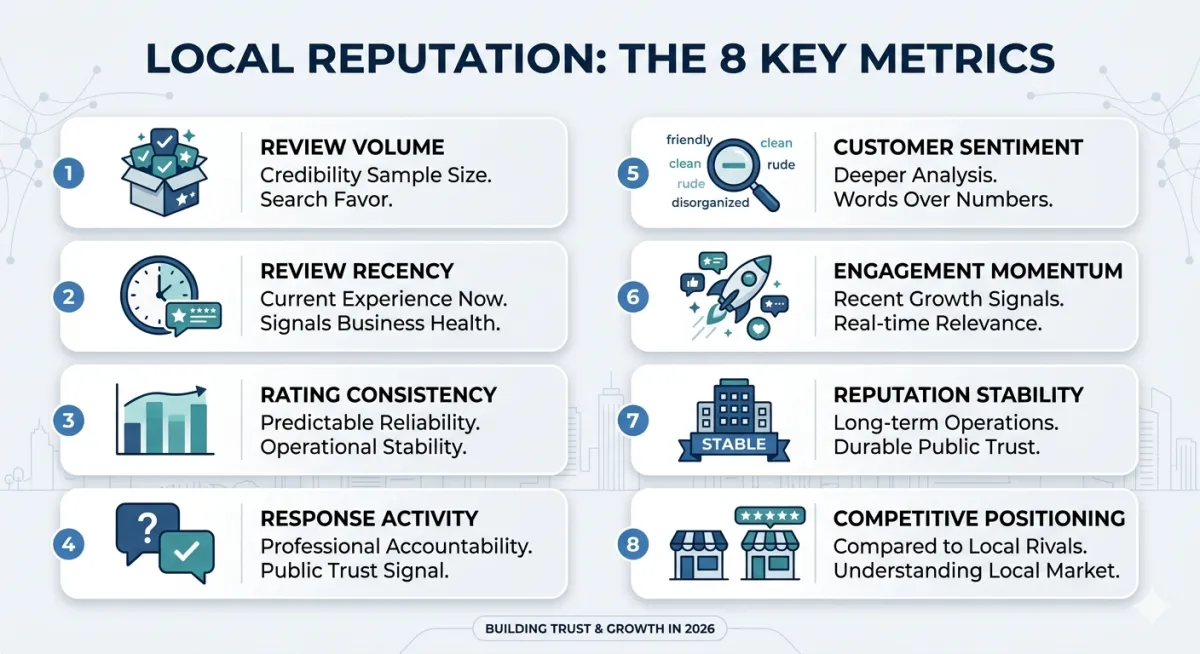
Here are the metrics that matter most for building and maintaining a strong local reputation in 2026.
1. Review Volume
One of the most obvious but important reputation signals is review volume.
Review volume refers to the total number of customer reviews a business has accumulated across platforms like Google. A business with hundreds or thousands of reviews generally appears more established and trustworthy than a business with only a handful of ratings.
Consumers naturally associate larger review counts with credibility. When customers compare two businesses with similar ratings, the one with more reviews often appears safer and more reliable.
For example:
A restaurant with a 4.7 rating and 2,500 reviews will usually appear more trustworthy than
A restaurant with a 4.9 rating and 22 reviews.
This is because customers understand that maintaining strong ratings over a large sample size is more difficult and more meaningful.
High review volume also impacts local search visibility. Search platforms tend to favor businesses that demonstrate strong customer activity and ongoing engagement.
However, review volume alone is not enough.
A business with thousands of old reviews but very little recent activity may still lose momentum to competitors generating consistent new customer feedback.
2. Review Recency
Review recency has become one of the most influential local reputation metrics.
Consumers want to know what a business experience looks like now — not two years ago.
Fresh reviews signal that:
The business is active
Customers are still visiting
Experiences remain consistent
The company continues delivering quality service
A business that receives regular weekly reviews often performs better than a competitor with a slightly higher rating but little recent activity.
This shift toward recency has become increasingly important as customer behavior changes faster than ever. Staff changes, management updates, renovations, menu adjustments, and operational improvements can all dramatically affect customer experience in short periods of time.
Recent reviews help consumers evaluate the current state of a business rather than relying on outdated information.
Businesses generating steady review momentum typically:
Build stronger customer trust
Maintain higher engagement
Perform better in local visibility
Stay more competitive over time
Consistent review recency signals long-term business health.
3. Rating Consistency
Many businesses focus entirely on average star ratings, but consistency matters just as much.
A company with a perfectly maintained reputation over time often performs better than a business experiencing large swings in customer satisfaction.
For example:
A business consistently maintaining ratings between 4.6–4.8 may appear more reliable than
A business fluctuating between 5-star experiences and 1-star complaints.
Consumers pay close attention to review patterns.
If reviews repeatedly mention:
inconsistent service
long wait times
changing quality
unreliable staff
communication problems
customers begin to lose confidence, even if the overall rating remains relatively high.
Consistency demonstrates operational stability.
Businesses that consistently deliver positive experiences create stronger long-term trust and customer retention.
Consistency also protects businesses during difficult periods. A company with years of stable customer satisfaction can often recover faster from occasional negative reviews than businesses already showing unstable patterns.
4. Response Activity
Customer engagement has become a major reputation signal.
Businesses that actively respond to reviews, both positive and negative, often build stronger public trust than businesses remaining silent.
Consumers increasingly expect interaction.
When businesses respond professionally, it signals:
attentiveness
accountability
customer care
operational involvement
Even short responses can positively impact customer perception.
For positive reviews, responses reinforce appreciation and strengthen loyalty.
For negative reviews, thoughtful responses demonstrate professionalism and willingness to resolve issues.
Importantly, customers are not only evaluating the original complaint — they are evaluating how the business handles criticism publicly.
A calm, professional response can often reduce the impact of negative reviews significantly.
Businesses that ignore reviews entirely may appear disengaged or inattentive.
In many industries, response activity now functions as a trust signal just as important as ratings themselves.
5. Customer Sentiment
Beyond numerical ratings, customer sentiment plays a critical role in local reputation.
Sentiment refers to the emotional tone and language customers use when discussing their experiences.
Two businesses may both hold 4.7-star averages, but the actual customer feedback may reveal very different realities.
Positive sentiment often includes words like:
friendly
reliable
clean
fast
professional
welcoming
consistent
Negative sentiment frequently includes:
rude
slow
overpriced
disorganized
inconsistent
disappointing
Modern reputation analysis increasingly evaluates these language patterns rather than relying solely on star averages.
Sentiment helps identify:
operational strengths
recurring complaints
customer priorities
emotional perception
This deeper analysis provides more accurate insight into real customer experiences.
Businesses with strong positive sentiment often outperform competitors even when star ratings appear similar.
6. Engagement Momentum
Momentum has become one of the most overlooked local reputation metrics.
Momentum measures how quickly a business is generating:
reviews
engagement
customer activity
public attention
Businesses experiencing strong momentum often gain visibility rapidly because they signal growth and active customer interest.
Momentum is especially important in highly competitive industries like:
restaurants
nightlife
coffee shops
fitness
salons
retail
A business consistently attracting new customers and reviews appears more relevant and popular than stagnant competitors.
Momentum also reflects current market performance better than lifetime averages alone.
For example:
A business that built strong ratings years ago but now receives very little activity may decline in relevance.
Meanwhile, a newer business generating fast customer engagement can quickly rise in visibility.
Momentum rewards businesses actively maintaining customer satisfaction in real time.
7. Reputation Stability
Long-term stability is one of the strongest indicators of operational quality.
Many businesses experience temporary spikes in popularity through:
viral social media attention
influencer marketing
promotions
advertising campaigns
But reputation stability measures whether positive customer experiences remain consistent over months and years.
Sustainable reputation growth matters more than temporary attention.
Businesses that consistently:
maintain strong reviews
generate customer engagement
respond professionally
avoid major quality drops
are more likely to build durable customer trust.
Stability creates predictability, and predictability builds confidence.
Customers want businesses they can rely on repeatedly.
8. Competitive Positioning
Local reputation is not measured in isolation.
Businesses compete directly against nearby competitors within the same industry.
Consumers almost always compare:
ratings
reviews
photos
engagement
responsiveness
reputation trends
before making decisions.
A strong reputation is relative to market competition.
For example:
A 4.5-star restaurant may perform extremely well in one city
but struggle in another market where competitors average 4.8.
This is why comparative reputation analysis matters.
Understanding local competition helps businesses:
identify weaknesses
improve positioning
track performance shifts
maintain relevance
The businesses that consistently dominate local markets are usually those monitoring competitor reputation activity regularly.
Why Reputation Metrics Matter More Than Ever
Consumer behavior has fundamentally changed.
Before visiting a business, customers now routinely:
search online
compare reviews
evaluate photos
read customer experiences
analyze ratings
check recent activity
Trust is increasingly formed before customers ever walk through the door.
Because of this, reputation metrics directly impact:
customer acquisition
conversion rates
local search visibility
brand perception
long-term revenue
Businesses with stronger reputations often benefit from:
increased customer trust
higher conversion rates
more repeat business
stronger word of mouth
greater pricing power
In competitive industries, reputation can become the deciding factor between two otherwise similar businesses.
The Future of Local Reputation
As platforms continue evolving, reputation analysis will likely become even more sophisticated.
Future local ranking systems will increasingly evaluate:
behavioral trends
customer sentiment
engagement quality
consistency over time
operational reliability
rather than relying only on simple star averages.
Businesses that prioritize long-term customer experience and reputation management will be positioned to outperform competitors as these systems evolve.
Reputation is no longer just marketing.
It is now a measurable business asset.
Final Thoughts
The strongest local reputations are not built overnight.
They are built through consistent customer experiences, steady engagement, operational reliability, and long-term trust.
Businesses that focus only on ratings often miss the deeper metrics shaping customer perception and competitive visibility.
Review volume, recency, consistency, engagement, sentiment, momentum, and stability all work together to influence how businesses are perceived online.
Understanding these metrics gives businesses a major advantage in increasingly competitive local markets.
As customer expectations continue to rise, reputation management will only become more important for businesses looking to grow, maintain visibility, and earn long-term customer trust.
