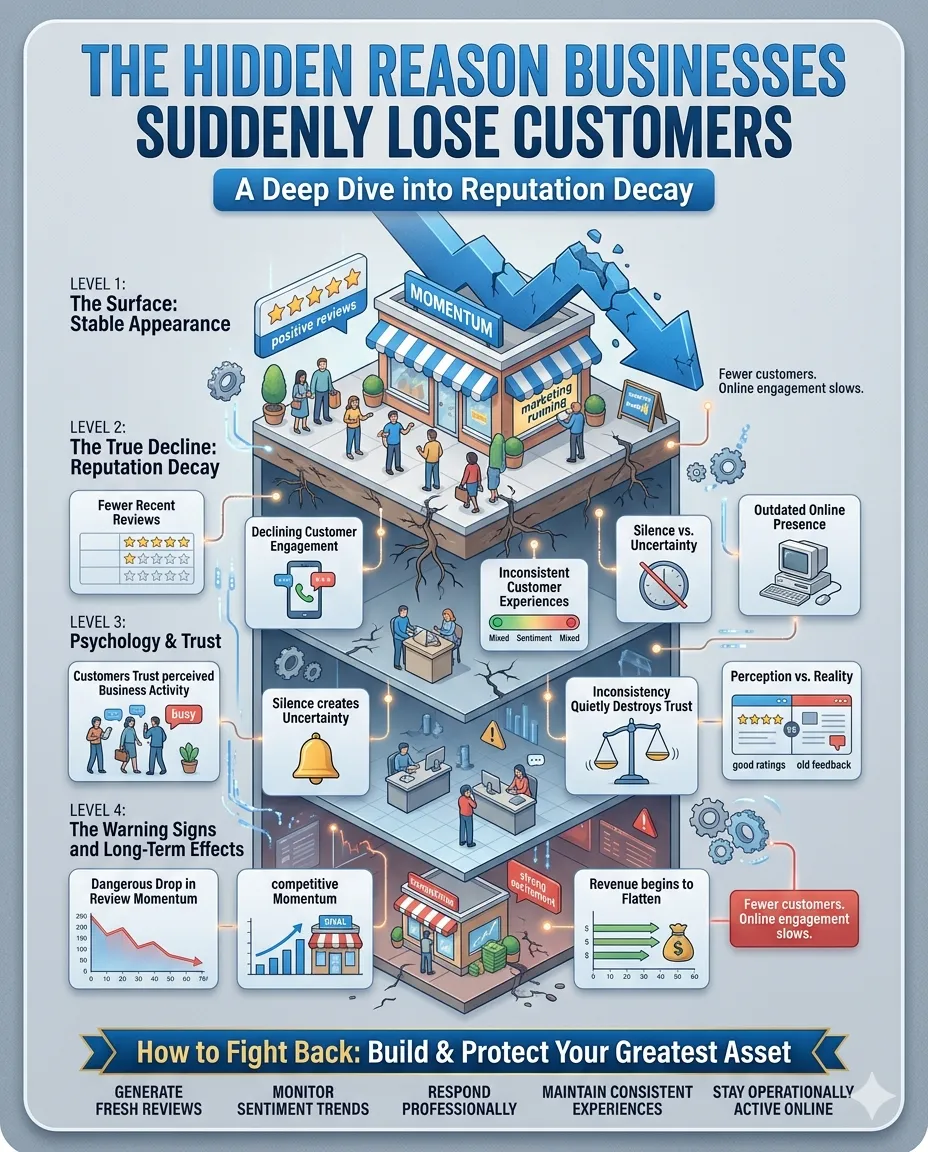
The Hidden Reason Businesses Suddenly Lose Customers
The Hidden Reason Businesses Suddenly Lose Customers
Every business owner eventually asks the same question:
“Why did business suddenly slow down?”
For many companies, customer loss does not happen overnight. It happens gradually, quietly, and often without obvious warning signs.
At first, everything seems stable:
Reviews are still positive
Customers still recognize the brand
The business still has a strong reputation
Marketing may still be running
But then momentum begins to shift.
Fewer customers walk through the door.
Online engagement slows down.
Competitors start gaining attention.
Repeat customers disappear.
Revenue begins to flatten.
Many business owners immediately blame:
the economy
advertising
pricing
competition
seasonality
While those factors can contribute, the real issue is often much deeper.
The hidden reason businesses suddenly lose customers is usually a decline in customer trust signals.
In today’s digital-first environment, businesses are constantly being evaluated online before customers ever make a purchase decision. Consumers are no longer choosing businesses based solely on brand familiarity or star ratings alone.
They are analyzing patterns.
And when those patterns begin to weaken, customers notice — even if business owners do not.
Reputation Decay Happens Quietly
One of the biggest misconceptions in local business is believing reputation is permanent.
It is not.
Reputation is dynamic.
A business that dominated its market two years ago can quickly lose visibility and customer trust if it stops maintaining strong engagement and consistent customer experiences.
This process is called reputation decay.
Reputation decay happens when businesses slowly lose the signals that previously made customers trust them.
This often includes:
fewer recent reviews
declining customer engagement
inconsistent experiences
outdated online presence
lack of response activity
weaker customer sentiment
Most businesses do not notice the decline immediately because the drop happens gradually.
But customers notice.
And modern search platforms notice too.
Customers Trust What Feels Active
One of the strongest psychological drivers behind customer decisions is perceived business activity.
Customers naturally trust businesses that appear:
busy
current
active
engaged
talked about consistently
When a business stops generating recent customer feedback, it begins to appear less relevant.
Even if the company still has strong lifetime ratings, customers often subconsciously question:
“Are people still going there?”
“Has quality changed?”
“Is this place still good?”
“Why are reviews slowing down?”
Fresh customer activity creates reassurance.
Silence creates uncertainty.
This is why businesses with slightly lower star ratings but strong recent momentum often outperform businesses with higher ratings and little recent engagement.
Customers trust movement.
The Dangerous Drop in Review Momentum
One of the earliest warning signs of customer loss is declining review momentum.
Review momentum refers to how consistently a business receives new customer feedback over time.
Healthy businesses typically maintain:
steady review activity
consistent engagement
recurring customer interaction
When review momentum slows, it often signals:
declining customer excitement
weaker customer experiences
reduced customer loyalty
lower referral activity
Even before revenue drops become obvious, online momentum often begins weakening first.
This matters because modern consumers heavily rely on recent customer validation before making decisions.
A business with:
3 reviews in the last month
may appear less trustworthy thana competitor generating 40 recent reviews consistently
even if both businesses have similar overall ratings.
Recency and momentum now shape visibility and trust more than ever.
Inconsistency Quietly Destroys Trust
Many businesses lose customers not because they become “bad,” but because they become inconsistent.
Customers can tolerate occasional mistakes.
What customers struggle with is unpredictability.
Common inconsistency issues include:
varying service quality
changing wait times
inconsistent communication
staffing problems
unreliable customer experiences
When customers begin encountering mixed experiences, confidence starts to decline.
And once confidence weakens, loyalty follows.
Consistency creates emotional safety for customers.
People want businesses they can rely on repeatedly.
A business that delivers a great experience one week but a frustrating experience the next creates hesitation — and hesitation sends customers toward competitors.
Customers Notice More Than Businesses Realize
Business owners often focus heavily on operational metrics like:
sales
expenses
staffing
marketing performance
Meanwhile, customers focus on emotional signals.
Customers pay attention to:
how recent reviews feel
how businesses respond publicly
whether experiences appear consistent
how active the business seems online
what other customers are saying right now
This creates a major disconnect.
A business owner may believe:
“We still have good reviews.”
Meanwhile, customers see:
old feedback
declining activity
inconsistent experiences
unresolved complaints
reduced excitement
Perception matters.
And online perception evolves constantly.
The Competitor Effect
Another hidden reason businesses suddenly lose customers is competitive momentum.
Even if a business remains stable, competitors improving faster can shift customer attention rapidly.
Customers constantly compare businesses online.
They compare:
review trends
customer engagement
photos
responses
atmosphere
activity levels
public sentiment
If competitors begin generating stronger customer excitement and visibility, customers naturally migrate toward businesses that appear more active and relevant.
In many industries, businesses are no longer competing only on:
price
quality
convenience
They are competing on perception.
And perception changes fast.
Ignoring Negative Reviews Makes Things Worse
Negative reviews alone rarely destroy businesses.
Ignoring them often does.
Customers understand that no business is perfect.
What matters more is how businesses respond when problems occur.
Businesses that:
ignore complaints
become defensive
avoid accountability
stop responding publicly
often create larger trust problems than the original issue itself.
Professional responses demonstrate:
attentiveness
care
accountability
operational involvement
Silence can make businesses appear disconnected or unconcerned.
Modern customers evaluate review responses almost as closely as the reviews themselves.
Reputation Momentum Drives Visibility
One of the most overlooked realities in local business is that visibility is closely tied to reputation momentum.
Businesses generating:
customer engagement
fresh reviews
strong sentiment
public interaction
tend to remain highly visible online.
Businesses losing momentum slowly fade from attention.
This affects:
customer trust
local search visibility
recommendations
referral activity
conversion rates
Momentum creates exposure.
Exposure creates traffic.
Traffic creates growth.
When momentum slows, customer acquisition often slows with it.
Why Businesses Often Notice Too Late
One reason customer loss feels “sudden” is because reputation decline happens before revenue decline becomes obvious.
By the time many businesses notice:
lower traffic
weaker sales
declining repeat customers
the underlying trust signals may have already been weakening for months.
This delayed effect creates the illusion that customer loss appeared suddenly.
In reality, the warning signs were usually visible earlier through:
reduced engagement
weaker review activity
inconsistent experiences
declining customer sentiment
Businesses that actively monitor reputation trends tend to identify problems much earlier.
How Businesses Protect Customer Trust
The businesses that maintain strong long-term growth usually focus heavily on reputation consistency.
They understand that customer trust requires ongoing maintenance.
Strong businesses consistently:
generate fresh reviews
encourage customer feedback
monitor sentiment trends
respond professionally
maintain consistent experiences
stay operationally active online
Most importantly, they treat reputation as a living business asset — not a one-time achievement.
Customer trust must be reinforced continuously.
The Businesses Winning in 2026
The businesses growing fastest today are not necessarily the businesses with:
the biggest advertising budgets
the most locations
the oldest brands
The businesses winning today are often the ones maintaining the strongest reputation momentum.
They understand that modern consumers value:
consistency
trust
activity
engagement
transparency
more than ever before.
In highly competitive industries, reputation has become one of the strongest predictors of long-term business success.
Final Thoughts
Businesses rarely lose customers for only one reason.
Customer decline is usually the result of weakening trust signals accumulating over time.
Review momentum slows.
Engagement decreases.
Experiences become inconsistent.
Competitors gain visibility.
Customer confidence weakens.
And eventually, customer behavior shifts.
The most successful businesses understand that reputation is not static.
It must be maintained consistently through customer experience, engagement, visibility, and operational reliability.
Because in today’s marketplace, customers are not just choosing the “best” business.
They are choosing the business that feels the most trustworthy right now.
