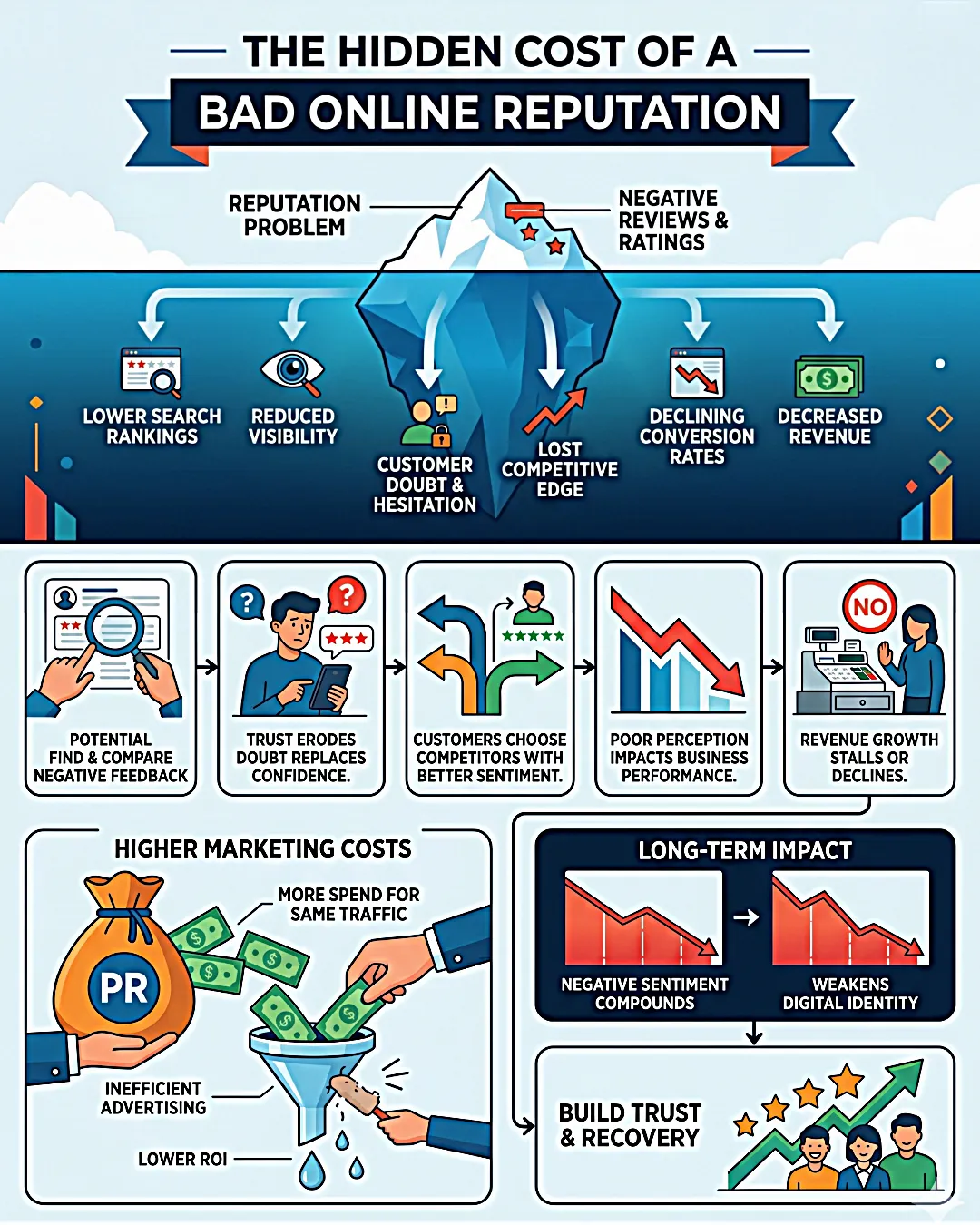
The Hidden Cost of a Bad Online Reputation
The Hidden Cost of a Bad Online Reputation
For many businesses, reputation is viewed as a branding issue. It is often associated with public perception, customer satisfaction, or marketing efforts. While those factors certainly matter, the reality is that reputation has become far more important than most business owners realize.
In today's digital economy, reputation directly influences visibility, trust, customer acquisition, and revenue. A poor online reputation is no longer simply an image problem. It is a business performance problem.
Whether a company operates locally, nationally, or entirely online, customer sentiment is constantly being measured through reviews, ratings, comments, recommendations, and engagement. These signals influence how platforms rank businesses, how consumers make purchasing decisions, and ultimately how much revenue a business can generate.
The cost of a bad online reputation often extends far beyond a few negative reviews.
Consumers Research Before They Buy
Modern consumers have access to more information than ever before. Before making a purchase, booking a service, or visiting a business, many people conduct extensive research online.
Potential customers routinely compare ratings, read reviews, analyze customer feedback, and evaluate overall sentiment before making a decision. In many cases, a business's online reputation becomes the first impression long before a customer ever visits a website or speaks with a representative.
This creates an important reality. Businesses are often being evaluated before they even know a potential customer exists.
A single negative experience may only affect one customer directly, but when that experience is documented online, it can influence hundreds or even thousands of future purchasing decisions.
The result is a reputation system that operates continuously, shaping customer behavior around the clock.
Trust Is Hard to Earn and Easy to Lose
Trust has always been one of the most valuable assets in business. What has changed is how quickly trust can be gained or lost in digital environments.
When consumers see a business with strong ratings, positive reviews, and consistent customer feedback, they naturally feel more confident moving forward. Strong reputation signals reduce uncertainty and make purchasing decisions easier.
The opposite is also true.
Low ratings, recurring complaints, and visible negative feedback create hesitation. Even if a business offers excellent products or services, poor reputation signals can create doubt in the minds of potential customers.
Most consumers do not have enough information to evaluate every aspect of a business. Instead, they rely on reputation as a shortcut for assessing risk.
If the reputation suggests uncertainty, many customers simply move on to a competitor.
Negative Reviews Impact More Than Customer Perception
Many business owners view reviews primarily as feedback from customers. In reality, reviews influence much more than public perception.
Search engines, marketplaces, directories, and recommendation platforms increasingly use review data as part of their ranking systems. Review quality, review volume, sentiment trends, and rating consistency all contribute to visibility.
This means negative reviews can create a double impact.
First, they reduce trust among potential customers.
Second, they may reduce the likelihood that potential customers see the business in the first place.
A business with declining ratings may experience lower rankings, fewer impressions, and reduced visibility across digital platforms. Over time, this can significantly impact customer acquisition efforts.
The damage often occurs quietly, making it difficult for businesses to identify the source of declining performance.
Reputation Influences Revenue More Than Many Businesses Realize
The relationship between reputation and revenue is often underestimated.
Businesses frequently focus on marketing campaigns, advertising budgets, and sales initiatives while overlooking how reputation influences conversion rates.
Consider two businesses offering similar products at similar prices.
One has hundreds of positive reviews, strong ratings, and consistently positive customer sentiment.
The other has mixed reviews, recurring complaints, and a lower overall rating.
Even if both businesses receive the same amount of traffic, the business with the stronger reputation will often convert significantly more customers.
This means reputation impacts not only customer acquisition but also the efficiency of every marketing dollar spent.
Businesses with stronger reputations typically extract more value from the same level of exposure because trust already exists before the customer arrives.
Customer Sentiment Creates Long-Term Business Momentum
One of the most overlooked aspects of reputation is the role of customer sentiment over time.
Most businesses focus on individual reviews, but platforms increasingly evaluate patterns rather than isolated incidents.
Recurring themes in customer feedback can reveal operational strengths and weaknesses. Positive sentiment surrounding service quality, reliability, communication, or product performance strengthens reputation over time.
Negative sentiment works the same way.
When customers repeatedly mention the same problems, those concerns become part of a business's digital identity.
Over time, these patterns influence both customer perception and platform algorithms.
This creates momentum that can either help or hurt long-term growth.
Positive sentiment compounds. Negative sentiment compounds as well.
Poor Reputation Creates Hidden Marketing Costs
Many businesses attempt to solve reputation issues by increasing marketing efforts.
While additional advertising may temporarily generate more traffic, it does not address the underlying trust problem.
In fact, businesses with poor reputations often face significantly higher customer acquisition costs.
When trust is low, conversion rates decline. Lower conversion rates require more traffic to generate the same number of customers. More traffic typically requires more marketing spend.
This creates a costly cycle where businesses spend increasing amounts of money to overcome reputation problems that continue limiting performance.
In many cases, improving reputation delivers a greater return on investment than increasing advertising budgets.
Recovery Requires More Than Damage Control
When businesses experience reputation challenges, the goal should not simply be removing negative feedback or responding to complaints.
Long-term reputation recovery requires operational improvements that address the root causes behind customer dissatisfaction.
Customers pay attention to patterns. Platforms pay attention to patterns as well.
Businesses that consistently improve customer experience, communication, service quality, and responsiveness often see reputation recover naturally over time.
The most successful companies view reputation management as an ongoing business strategy rather than a reactive public relations exercise.
Reputation Is Becoming a Competitive Advantage
As digital platforms continue to influence consumer behavior, reputation is becoming one of the most important competitive advantages a business can possess.
Products can be copied.
Pricing strategies can be matched.
Marketing campaigns can be replicated.
Trust is far more difficult to duplicate.
Businesses that consistently earn positive customer sentiment build a foundation that competitors cannot easily recreate. Every positive review, satisfied customer, and strong interaction contributes to a reputation asset that grows stronger over time.
In many industries, reputation has become one of the most valuable forms of business equity.
Final Thoughts
A bad online reputation rarely appears as a line item on a financial statement.
There is no monthly report showing lost trust, missed opportunities, or customers who chose a competitor because of negative reviews.
Yet those costs exist every day.
Poor ratings, negative sentiment, and declining customer trust influence visibility, conversion rates, customer acquisition costs, and long-term revenue growth. The impact often occurs gradually, making it easy to underestimate until meaningful damage has already occurred.
The businesses that thrive in today's digital marketplace understand that reputation is not simply a reflection of performance.
It is a driver of performance.
The strongest companies are not just managing their reputation.
They are actively building it, knowing tha
