The Death of Organic Reach: What Replaced It in 2026
The Death of Organic Reach: What Replaced It in 2026
For over a decade, “organic reach” was the foundation of digital marketing strategy. Brands built audiences on Facebook pages, Instagram feeds, and Twitter timelines with the expectation that posting great content would naturally lead to visibility. That era is now over.
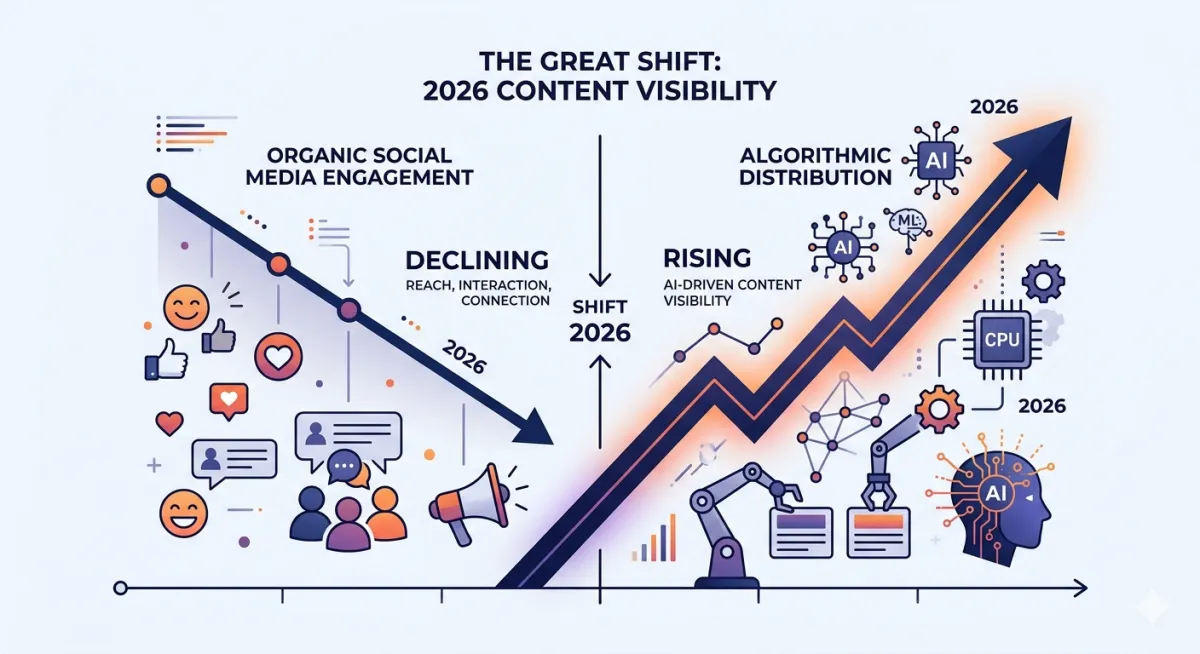
In 2026, organic reach as marketers once understood it no longer exists in any meaningful form. Not because content stopped mattering—but because distribution itself has fundamentally changed. Platforms no longer behave like open networks. They behave like predictive engines.
What replaced organic reach is not a single system, but a layered ecosystem of algorithmic distribution, AI-curated visibility, and engagement-weighted amplification. And for brands, creators, and businesses, this shift changes everything about how attention is earned.
Why Organic Reach Died (It Wasn’t Sudden)
The decline of organic reach wasn’t a single update or algorithm change. It was a slow structural shift driven by three major forces.
First, platforms became saturated. Every feed is now an infinite stream of competing content. As more creators entered the ecosystem, platforms had to make choices about what users actually see.
Second, advertising pressure increased. Platforms like Meta, TikTok, and YouTube optimized heavily for monetization. That naturally reduced unpaid distribution space.
Third—and most important—user behavior changed. People no longer browse content chronologically or even socially. They expect platforms to predict what they want before they know it themselves.
These three forces combined to make traditional “post and hope” organic reach ineffective. The feed stopped being a timeline and started becoming a recommendation engine.
What Replaced Organic Reach: The Algorithmic Visibility Layer
In 2026, content distribution is no longer about who follows you. It’s about how the algorithm categorizes you.
Every post is now evaluated through what can be described as an “algorithmic visibility layer.” Instead of distributing content evenly to followers, platforms test content in micro-audiences based on predicted interest.
If early engagement signals are strong, content expands outward. If not, it disappears—often within minutes.
This means reach is no longer stable or predictable. It is earned dynamically in real time.
The key shift is this:
Distribution is no longer granted. It is simulated.
Platforms simulate potential interest, test content against it, and scale accordingly. That simulation has replaced organic reach entirely.
Engagement Weighting Became the New Currency
Likes used to matter. Then shares mattered. Then watch time mattered. Now, engagement is no longer a flat metric—it’s weighted behavior.
A comment from a highly engaged user may carry more algorithmic weight than 100 passive likes. A full video watch is more valuable than multiple partial views. A save or share signals stronger intent than any surface-level interaction.
This has created a new reality: not all engagement is equal.
Brands that still optimize for vanity metrics are effectively speaking an outdated language. The algorithm is not counting engagement—it is interpreting it.
AI Curators Replaced Chronological Feeds
Another major shift is the rise of AI-driven content curation layers inside platforms.
Rather than simply ranking content, platforms now activelyinterpret user intent. Your feed is no longer based on who you follow or what you liked yesterday. It is based on what the system predicts will hold your attention today.
This AI curation behaves more like a personalized TV channel than a social feed.
And this is where organic reach fully disappears:
Even your own followers are no longer guaranteed to see your content.
Visibility is now conditional, not automatic.
The Rise of “Distribution Signals”
In this new ecosystem, content is not judged broadly—it is evaluated through distribution signals.
These signals include:
Early retention rates (first 3–10 seconds matter most)
Rewatch behavior
Comment sentiment quality (not just quantity)
Share velocity within niche clusters
Profile interaction after viewing
If a post triggers strong signals in a specific cluster, it gets pushed deeper into similar clusters.
If not, distribution stops.
This means success is no longer about broad appeal. It’s aboutprecise resonance.
Why Followers Don’t Guarantee Reach Anymore
One of the most disruptive changes in 2026 is the decoupling of followers from visibility.
A creator with 500,000 followers can now easily outperform a brand with 5 million followers—or vice versa—depending entirely on content performance in the algorithm.
Followers are now more of a “potential audience pool” than an active distribution channel.
This has fundamentally changed creator economics. Influence is no longer stored in audience size. It is stored in content performance history.
What Brands Got Wrong About the Transition
Many businesses initially assumed this shift meant “organic is dead, so we must pay for reach.”
That’s not accurate.
Paid reach and organic distribution are now deeply intertwined. Ads are often fed into the same algorithmic systems as organic content. The difference is not channel—it’s optimization.
Brands that failed adapted in three common ways:
They kept posting legacy content designed for chronological feeds
They over-relied on follower count as a success metric
They ignored retention-focused storytelling formats
Meanwhile, brands that adapted started thinking like content engineers, not publishers.
What Actually Works Now: The New Organic Strategy
Even though “organic reach” is dead, organicdistributionstill exists—but it looks completely different.
Successful strategies in 2026 focus on:
1. Retention-first content design
Content must earn attention in the first seconds or it is filtered out.
2. Niche clustering
Instead of broad audiences, content is optimized for tightly defined interest groups.
3. Serial content ecosystems
Single posts rarely perform consistently. Series-based content builds algorithmic momentum.
4. Engagement depth over engagement volume
Meaningful comments and saves matter more than surface interactions.
5. Platform-native storytelling
Content that feels “native” to the platform outperforms repurposed marketing material.
The Attention Economy Replaced the Reach Economy
The biggest conceptual shift is this:
We no longer live in a reach economy. We live in an attention economy.
Reach used to be about how many people saw your content.
Attention is about how long people stay with it—and how deeply they engage.
This is why short-form video, interactive content, and narrative-driven posts dominate today. They are optimized not for exposure, but for sustained attention loops.
What This Means for the Future of Marketing
Marketing teams can no longer rely on predictable distribution channels. Instead, they must operate like adaptive systems.
Success now requires:
Constant testing
Rapid iteration
Deep audience understanding
Platform-specific creative strategy
Real-time performance feedback loops
The brands that win in this environment are not the ones with the most content—but the ones that understand how content is evaluated by machines.
Conclusion
The death of organic reach did not eliminate opportunity—it redefined it.
In 2026, visibility is no longer something you build once and maintain. It is something you continuously earn through performance, relevance, and engagement quality.
What replaced organic reach is more complex, more dynamic, and more competitive—but also more merit-based in a strange way. Content that resonates truly can still break through. It just has to survive a more intelligent gatekeeper than ever before: the algorithm itself.
The challenge for brands is no longer “How do we get seen?”
It is now “How do we deserve to be shown?”
