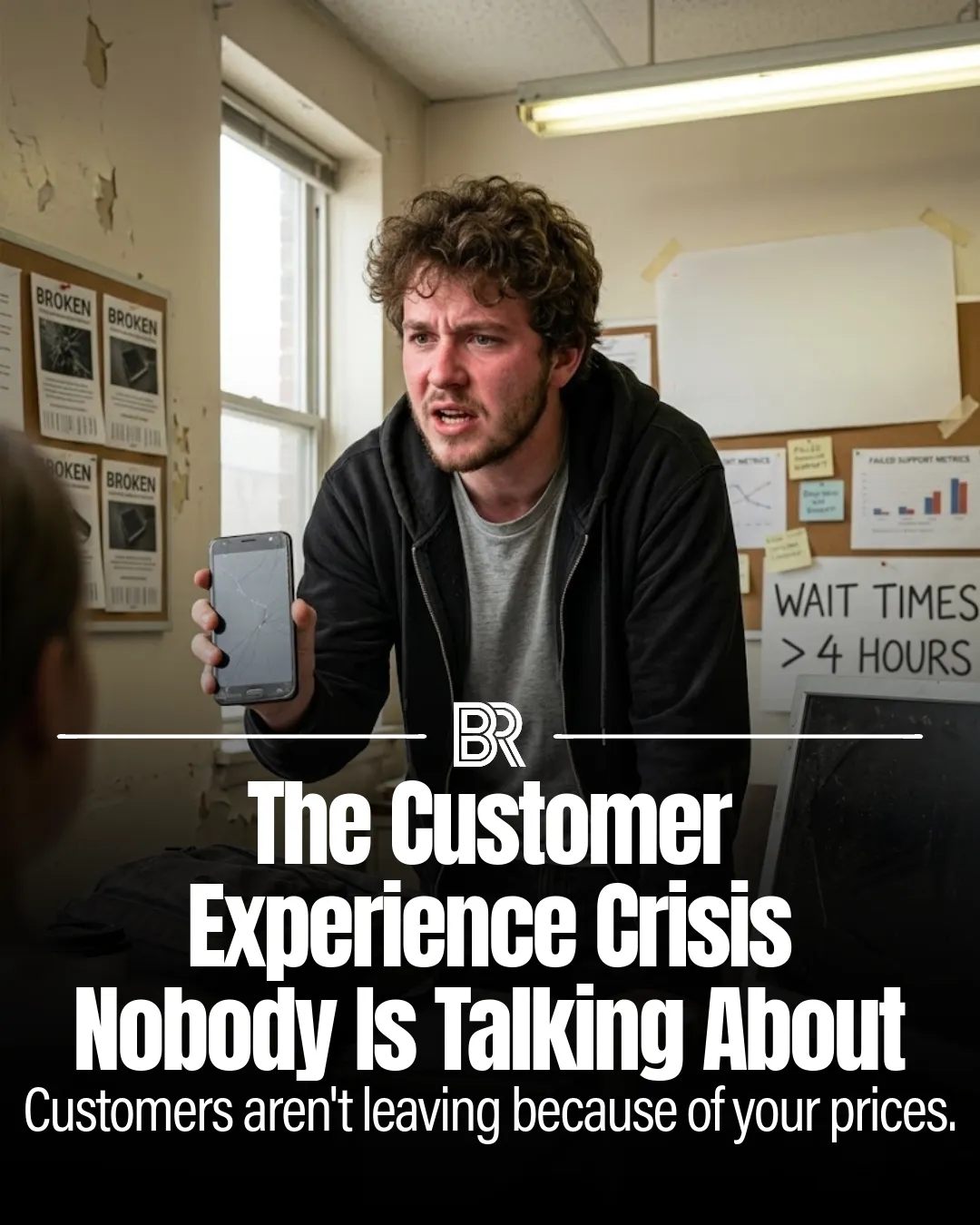
The Customer Experience Crisis Nobody Is Talking About
The Customer Experience Crisis Nobody Is Talking About
For years, businesses have focused on competing through price, products, technology, and marketing.
But in 2026, a different battle is taking place.
It's happening every time a customer calls for support, sends a message through social media, leaves a review, or tries to resolve a problem.
The reality is that customer frustration is rising across nearly every industry. Consumers are increasingly encountering long wait times, confusing support systems, automated responses that fail to solve problems, hidden fees, billing issues, and businesses that simply fail to communicate effectively.
The result?
Customer experience has quietly become one of the biggest competitive advantages a business can have.
While many companies continue investing heavily in advertising and customer acquisition, the businesses winning today are often the ones delivering the simplest thing of all: a better customer experience.
Consumers Are More Frustrated Than Ever
Recent consumer research suggests frustration levels have reached concerning levels.
According to the National Consumer Rage Survey, nearly 80% of Americans experienced a problem with a product or service in the past year, while roughly two-thirds reported feeling significant frustration during those interactions. Common complaints included billing mistakes, poor communication, overcharges, hidden fees, and difficulty reaching someone who could actually solve their problem.
For many consumers, these issues aren't isolated incidents.
They're becoming a routine part of daily life.
Whether it's attempting to cancel a subscription, disputing a charge, scheduling an appointment, or getting support from a local business, customers increasingly expect friction before they expect solutions.
This growing frustration creates a major challenge for businesses.
Every poor interaction chips away at trust.
And trust is becoming harder to earn than ever before.
The Rising Expectations Problem
Customer expectations have changed dramatically over the past decade.
Consumers now compare every experience against the best experience they've ever had.
If a customer receives instant updates from a rideshare app, they expect similar communication from a contractor.
If a retailer provides same-day support, customers begin expecting the same responsiveness from a healthcare provider, law firm, or restaurant.
Research from Verint's 2026 State of Customer Experience report found that 42% of consumers report higher service expectations than they had previously, while 79% say they would switch to a competitor after a single negative experience.
This means businesses no longer compete only against direct competitors.
They compete against every positive customer experience consumers encounter elsewhere.
A single poor interaction can now outweigh years of brand loyalty.
Why Technology Isn't Solving the Problem
Many organizations assumed technology would improve customer experience.
In some ways, it has.
Online scheduling, self-service portals, live chat, and automation have made many tasks easier.
However, technology has also introduced new frustrations.
Consumers increasingly report becoming trapped in chatbot loops, struggling to reach human representatives, or receiving generic automated responses that fail to address their issues. Industry surveys show many customers are comfortable using AI when it resolves their problems quickly, but become frustrated when automation becomes a barrier instead of a solution.
The problem isn't necessarily AI.
The problem is poor implementation.
Customers don't care whether they're speaking to a human or a machine.
They care whether their issue gets resolved.
Businesses that use automation to enhance customer support often succeed.
Businesses that use automation simply to reduce costs often create frustration.
The Hidden Cost of Poor Customer Experience
Most business owners understand the cost of losing a customer.
What many underestimate is how quickly poor experiences spread.
Today's customers don't simply leave.
They leave reviews.
They post on social media.
They tell friends and family.
They share experiences in community groups and online forums.
A negative customer interaction that once disappeared quietly can now influence hundreds or even thousands of future purchasing decisions.
This creates a ripple effect that impacts far more than immediate revenue.
Poor customer experiences can reduce referral rates, weaken brand trust, increase marketing costs, and damage online reputation.
In some industries, a single negative review may be viewed by more prospective customers than any advertisement the business runs.
That's why customer experience and reputation management are now inseparable.
The Growing Reputation Gap
One of the most interesting findings emerging from customer experience research is the disconnect between how businesses perceive their performance and how customers actually feel.
Recent customer experience studies found that while 66% of organizations believe customer experience is improving, only 17% of consumers agree.
This gap creates significant risk.
Many businesses assume they're delivering excellent service because they rarely hear complaints directly.
In reality, frustrated customers often leave without saying anything.
They simply choose a competitor next time.
This silent churn can be far more dangerous than public criticism because it often goes unnoticed until revenue begins declining.
The businesses that close this perception gap are typically those that actively seek feedback, monitor reviews, and continually evaluate customer interactions rather than relying on assumptions.
Speed Has Become a Competitive Advantage
One of the clearest trends emerging in 2026 is the growing importance of response time.
Customers no longer think in days.
They often think in minutes.
Whether they're sending a message through Instagram, requesting information through a website, or emailing a business directly, consumers increasingly expect immediate acknowledgment.
Research indicates that speed is now one of the strongest drivers of customer satisfaction, often outweighing communication channel preferences. Customers are generally willing to use automation if it provides fast, effective resolution.
This doesn't mean every problem must be solved instantly.
It means customers want reassurance that someone is listening.
Even a simple acknowledgment can dramatically improve customer perception.
Businesses that respond quickly create confidence.
Businesses that leave customers waiting create uncertainty.
And uncertainty often leads to frustration.
What the Best Businesses Are Doing Differently
The organizations earning the highest customer satisfaction scores aren't necessarily the largest companies.
They're the businesses that make customers feel valued.
Across industries, successful businesses tend to share several common characteristics:
They communicate proactively.
They make it easy to reach a real person when needed.
They simplify customer journeys.
They respond quickly.
They follow up after problems are resolved.
And perhaps most importantly, they treat customer feedback as valuable data rather than criticism.
These businesses understand that every interaction contributes to their reputation.
Instead of viewing customer experience as a support function, they view it as a growth strategy.
Customer Experience Is the New Marketing
For years, marketing was primarily about attracting attention.
Today, customer experience often determines whether that attention turns into revenue.
The most effective advertising campaign in the world cannot consistently overcome poor customer experiences.
Customers trust other customers.
They trust reviews.
They trust recommendations.
They trust demonstrated reliability.
Every positive interaction creates an opportunity for loyalty, referrals, and advocacy.
Every negative interaction creates an opportunity for churn.
As competition continues increasing across nearly every industry, businesses that prioritize customer experience are positioning themselves for long-term growth.
Final Thoughts
The customer experience crisis isn't making headlines every day.
But it's quietly affecting businesses everywhere.
Consumers are more frustrated.
Expectations are higher.
Patience is lower.
And online reviews ensure that customer experiences are more visible than ever before.
The businesses that recognize this shift have an opportunity to stand out.
Not by offering the lowest prices.
Not by spending the most on advertising.
But by delivering something increasingly rare:
A smooth, responsive, trustworthy customer experience.
In 2026, that may be one of the most valuable competitive advantages a business can have.
