SEO Is No Longer Enough: The 5 Layers of Search Visibility Every Business Needs in 2026
SEO Is No Longer Enough: The 5 Layers of Search Visibility Every Business Needs in 2026
For nearly two decades, digital marketing revolved around a relatively simple goal:
Rank higher on Google.
Businesses invested heavily in keywords, backlinks, technical optimization, and content creation because the rules were clear. The higher you ranked, the more traffic you received. The more traffic you received, the more opportunities you had to generate leads, sales, and customers.
That strategy worked.
In many cases, it still does.
But something fundamental has changed.
Consumers no longer rely exclusively on traditional search engines to find information.
They ask questions inside AI assistants.
They discover businesses through recommendation engines.
They receive direct answers without clicking links.
They interact with generative AI platforms that summarize information on their behalf.
They consume information through conversations rather than search results.
In short, search behavior has evolved.
The challenge is that many businesses are still optimizing for the internet of 2015 while consumers are increasingly using the internet of 2026.
Ranking on Google remains important, but it is no longer the entire visibility strategy.
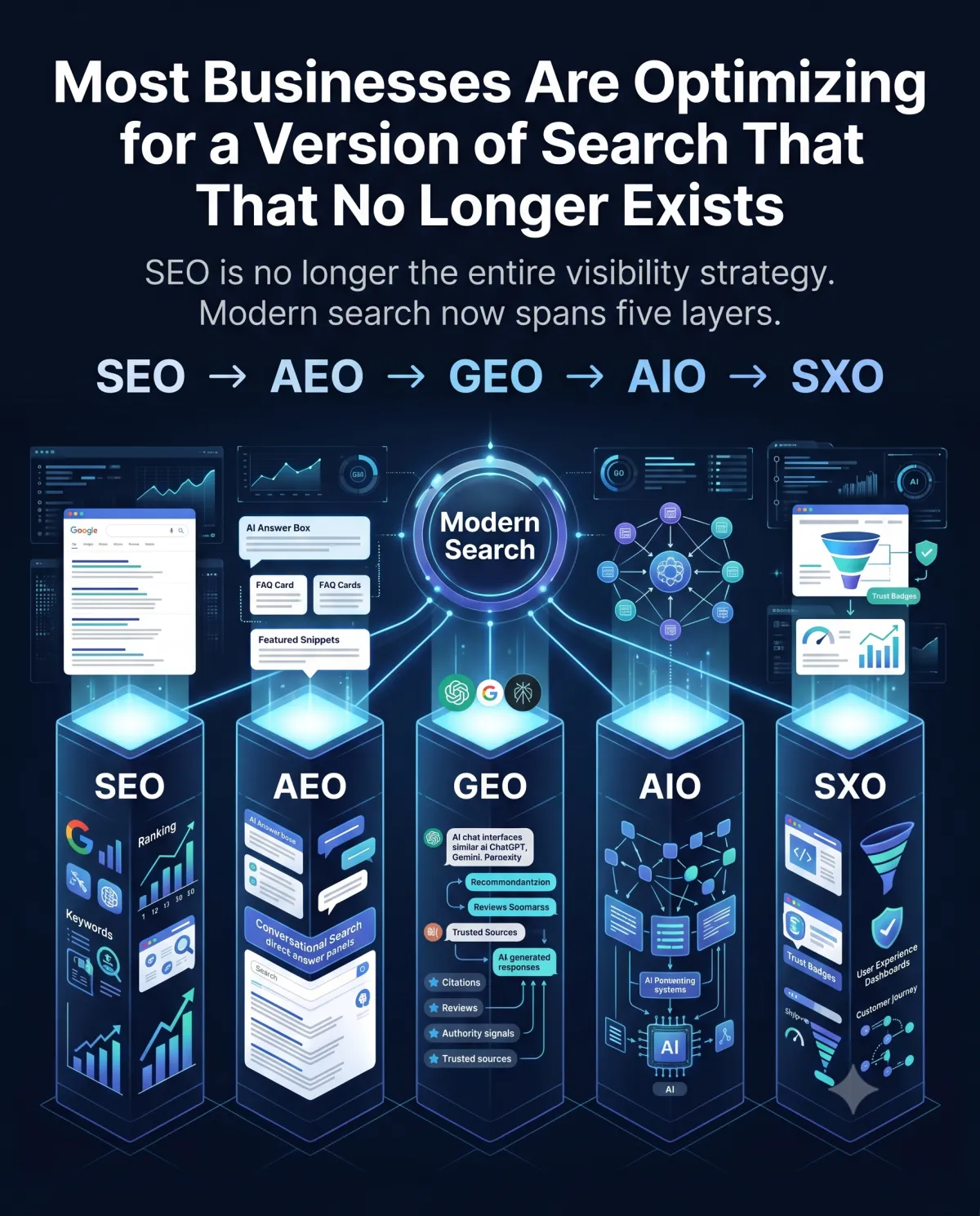
Modern search has expanded into five interconnected layers:
• SEO (Search Engine Optimization)
• AEO (Answer Engine Optimization)
• GEO (Generative Engine Optimization)
• AIO (AI Optimization)
• SXO (Search Experience Optimization)
Businesses that understand all five layers are positioning themselves for the future of digital visibility.
Businesses that focus only on traditional SEO risk becoming increasingly difficult to discover.
Layer 1: SEO Remains the Foundation
Search Engine Optimization is still the starting point.
Despite the rise of AI search and conversational interfaces, traditional search engines continue to drive enormous amounts of traffic across nearly every industry.
SEO includes:
• Keyword research
• Technical optimization
• Site speed
• Internal linking
• Content strategy
• Mobile optimization
• Crawlability
• Indexation
• Backlink acquisition
• Site architecture
Think of SEO as the foundation of a house.
Without a strong foundation, everything built on top becomes unstable.
Search engines still need to understand your website, your content, and your authority within your industry.
Businesses that ignore SEO entirely often struggle to gain visibility regardless of how strong their products or services may be.
However, a common mistake is assuming SEO is the entire strategy.
It is not.
SEO gets your business into the conversation.
The remaining four layers determine whether you continue being visible as search evolves.
Layer 2: AEO Is About Winning Answers
Answer Engine Optimization represents one of the biggest shifts in online behavior.
People increasingly want answers, not lists of links.
Search engines recognize this.
That is why featured snippets, AI summaries, FAQ sections, and direct-answer boxes continue expanding across search results.
Consumers are becoming accustomed to receiving information immediately.
Instead of clicking through ten different websites, they expect concise and trustworthy answers within seconds.
This changes how content should be created.
Businesses must begin thinking beyond keywords.
They must think about questions.
AEO focuses on:
• Answer-first content
• FAQ pages
• Featured snippet optimization
• Structured content
• Schema markup
• Concise explanations
• Clear headings
• Question-based content formats
The goal is to become the source chosen when an answer engine needs information.
Businesses that consistently provide useful, direct answers increase their chances of appearing in answer boxes and AI-generated summaries.
The future of search belongs to businesses that can communicate expertise clearly and efficiently.
Layer 3: GEO Is About Being Recommended
Generative Engine Optimization may become one of the most important developments in digital marketing over the next decade.
Consumers are increasingly asking platforms like ChatGPT, Gemini, Claude, and Perplexity for recommendations.
Instead of typing:
"Best accounting software"
Users might ask:
"What accounting software would you recommend for a growing small business?"
The difference is significant.
Traditional search produces links.
Generative search produces recommendations.
That means visibility is no longer solely determined by rankings.
It is increasingly influenced by trust signals.
GEO focuses on factors such as:
• Online reviews
• Citations
• Third-party mentions
• Brand authority
• Reputation
• Entity recognition
• Industry references
• Trusted publications
• Public sentiment
This creates a major opportunity for businesses with strong reputations.
AI systems often look beyond a company's website when evaluating credibility.
They analyze broader signals from across the internet.
This is where reputation management becomes increasingly important.
Reviews are no longer just customer feedback.
They are becoming visibility signals.
Mentions are no longer just public relations wins.
They are becoming recommendation signals.
The future of search is not simply about ranking.
It is about being recommended.
Why Reputation Matters More Than Ever
For years, businesses viewed reviews primarily as a customer service issue.
Today, reviews influence visibility across multiple layers of search.
Strong reviews help:
• Build consumer trust
• Improve local search performance
• Influence AI recommendations
• Strengthen authority signals
• Improve conversion rates
This is one reason platforms like BusinessRate have become increasingly relevant.
The ability to measure and analyze reputation performance is becoming a competitive advantage.
As AI systems continue incorporating broader trust signals into their decision-making processes, businesses with stronger reputations are likely to become more visible.
The businesses that win will not necessarily be those with the biggest marketing budgets.
They may be the businesses with the strongest customer experiences.
Layer 4: AIO Is About Helping AI Understand You
AI Optimization focuses on making your business easier for artificial intelligence systems to understand.
Humans and AI process information differently.
A person can visit a website and infer context from design, wording, imagery, and experience.
AI relies heavily on structure.
This means businesses must increasingly focus on:
• Structured data
• Knowledge graphs
• Machine-readable content
• Entity clarity
• Consistent brand information
• Trusted sources
• Schema markup
• Metadata optimization
Imagine two companies with similar services.
One has organized, structured, machine-readable information.
The other has inconsistent information scattered across various platforms.
Which company is easier for AI to understand?
The answer is obvious.
As AI continues becoming a primary discovery tool, clarity will become a competitive advantage.
Businesses that proactively organize their digital presence today will be positioned to benefit tomorrow.
Layer 5: SXO Turns Visibility Into Revenue
Many businesses obsess over traffic.
Fewer businesses focus on what happens after the click.
Search Experience Optimization addresses that gap.
SXO combines traditional search visibility with customer experience and conversion optimization.
After all, traffic alone does not create revenue.
Visitors must trust what they find.
They must understand the offer.
They must feel confident enough to take action.
SXO focuses on:
• Page speed
• Mobile usability
• Navigation
• Conversion optimization
• Trust signals
• Customer experience
• Calls to action
• Landing page effectiveness
• Content readability
Imagine two businesses receiving identical traffic.
One converts visitors into customers.
The other does not.
The difference is often SXO.
Visibility without conversion is simply an expensive vanity metric.
Businesses that optimize both discovery and experience consistently outperform those focused solely on rankings.
The Biggest Opportunity in 2026
Most businesses still allocate nearly all of their visibility efforts toward traditional SEO.
That approach is understandable.
SEO has delivered results for years.
But the search landscape is becoming increasingly fragmented.
Consumers now discover businesses through:
• ChatGPT
• Gemini
• Claude
• Perplexity
• YouTube
• Social search
• AI Overviews
• Recommendation engines
• Review platforms
Visibility now exists across multiple ecosystems.
The businesses that adapt early gain an advantage.
Those that continue treating visibility as a single-channel challenge may find themselves increasingly difficult to discover.
The New Visibility Formula
The future of digital visibility is not about replacing SEO.
It is about expanding beyond it.
SEO remains essential.
But it now works alongside AEO, GEO, AIO, and SXO.
Together, these five layers create a more resilient visibility strategy capable of adapting to changing consumer behavior and emerging technologies.
The businesses that win in 2026 will not simply be the easiest to find.
They will be the easiest to trust.
The easiest to understand.
The easiest to recommend.
And the easiest to do business with.
Final Thoughts
Search is evolving faster than at any point in its history.
Consumers are moving from searching to asking.
From clicking to conversing.
From browsing to receiving recommendations.
The businesses that recognize this shift now have an opportunity to position themselves ahead of competitors who are still focused exclusively on rankings.
The future belongs to organizations that build visibility across all five layers of modern search.
The question is no longer whether your business ranks on Google.
The question is whether your business can be discovered, understood, trusted, recommended, and chosen wherever consumers search next.
