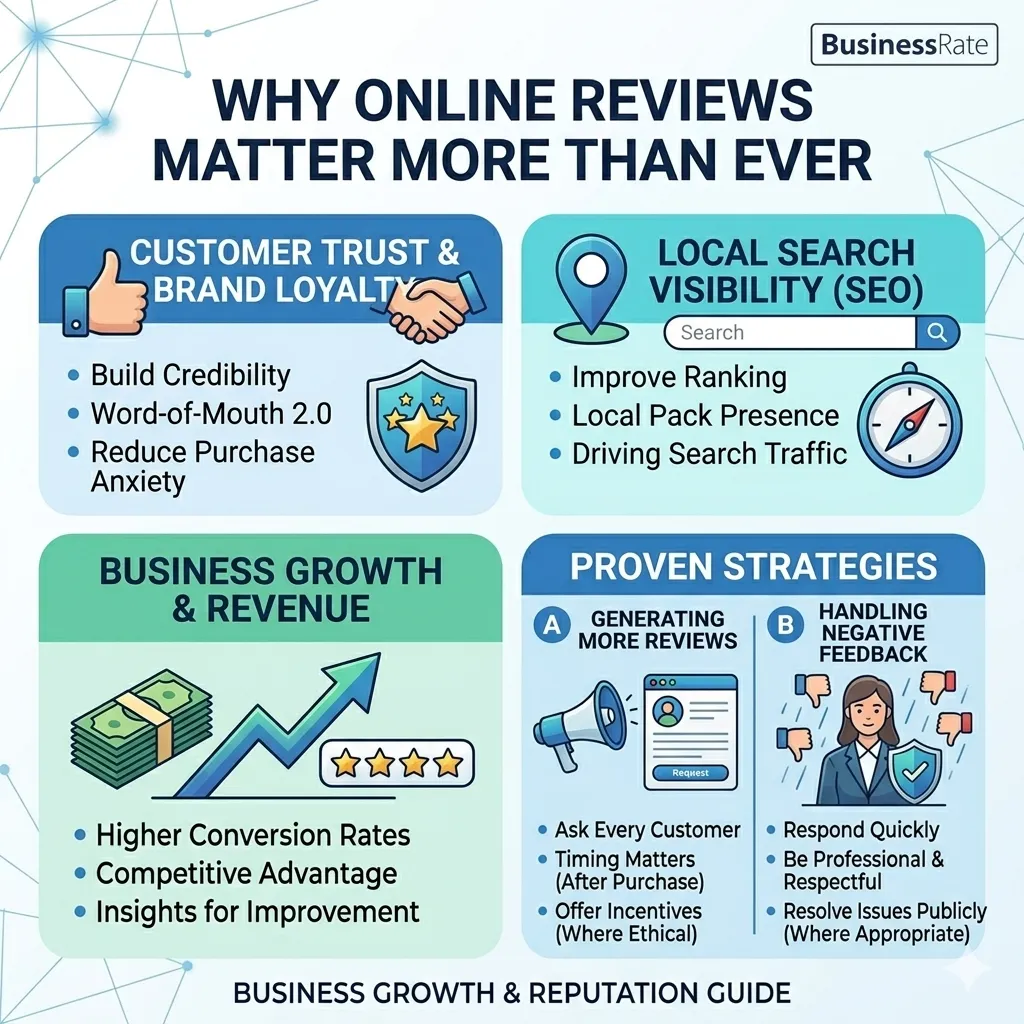
Why Online Reviews Matter More Than Ever
Why Online Reviews Matter More Than Ever
Online reviews have become one of the most powerful factors influencing whether a customer chooses your business or your competitor.
In most local industries today, customers no longer rely on ads alone. They rely on what other people say about you.
Before making a decision, they check:
Your Google rating
The number of reviews you have
How recent those reviews are
What people are actually saying
This means your reputation is no longer something passive. It is an active part of your sales process.
A strong reputation can bring in consistent customers without increasing ad spend.
A weak one can quietly drain opportunities, even if your service is excellent.
How Reviews Influence Customer Trust
Trust is the foundation of every buying decision, especially for local businesses.
When a potential customer sees your business for the first time, they are not judging your website or your ads first.
They are judging your reviews.
Here’s what typically happens:
A 4.5–5.0 rating builds immediate confidence
A large number of reviews signals experience and reliability
Recent reviews show that your business is active and consistent
Detailed positive feedback reduces perceived risk
On the other hand:
Few reviews create uncertainty
Old reviews make a business feel inactive
Negative reviews without responses reduce trust instantly
In many cases, customers will choose a slightly more expensive business simply because it has better reviews.
That is how powerful reputation has become.
The Psychology Behind Reviews
Reviews work because they remove uncertainty.
People are not just buying a product or service. They are buying confidence in the outcome.
When someone sees positive reviews, they are essentially seeing proof that:
Other people had a good experience
The business delivers on its promises
The risk of making a bad decision is lower
This is called social proof.
And in local search, social proof often matters more than branding or advertising.
Even a small difference in rating can change conversion rates significantly.
For example:
A 4.2 rating may generate hesitation
A 4.6 rating feels much more trustworthy
A 4.8+ rating often feels like a “safe choice”
That small gap can determine who gets the customer.
Why Review Quantity Matters Just as Much as Rating
Many business owners focus only on their average rating.
But volume matters just as much.
A 4.8 rating with 20 reviews does not carry the same weight as a 4.7 rating with 500 reviews.
Why?
Because volume signals consistency.
More reviews suggest:
Long-term reliability
A steady flow of customers
Lower risk of manipulation or bias
Google also uses review volume as a trust signal in local rankings.
So businesses with more reviews tend to:
Rank higher
Get more visibility
Attract more customers
Generate even more reviews
This creates a compounding advantage over time.
The Best Strategies to Generate More Reviews
Getting reviews consistently is one of the biggest challenges for local businesses, but it is also one of the most important growth levers.
Here are the most effective strategies:
1. Ask at the Right Time
Timing is everything.
The best moment to request a review is immediately after a positive experience:
After a completed service
After a successful purchase
After a customer expresses satisfaction
At this moment, the customer is most likely to respond positively.
2. Make It Simple
Customers are far more likely to leave a review if the process is easy.
The best approach:
Send a direct Google review link
Use SMS instead of email when possible
Reduce steps to one click
If it takes effort, most customers won’t do it.
3. Build It Into Your Process
The most successful businesses do not “hope” for reviews.
They systemize them.
This means:
Every job includes a review request
Staff are trained to ask consistently
Automated follow-ups are used when possible
Consistency is what drives volume.
4. Incentivize the Experience, Not the Review
You should never pay for reviews, but you can improve the experience that leads to them.
This includes:
Better communication
Faster response times
Follow-up care
Personal connection with customers
Great experiences naturally lead to more reviews.
How to Handle Negative Reviews Properly
Negative reviews are unavoidable.
Every business gets them.
What matters is how you respond.
Ignoring them or responding emotionally can damage your reputation more than the review itself.
The Right Approach:
1. Respond Quickly
A fast response shows you care and are actively managing your reputation.
2. Stay Professional
Never argue or get defensive. Even if the customer is wrong, your response is visible to future customers.
3. Acknowledge the Issue
A simple acknowledgment goes a long way:
“We’re sorry you had this experience…”
4. Offer Resolution
Where possible, provide a solution or invite them to continue the conversation privately.
Why Negative Reviews Can Actually Help
While negative reviews feel damaging, a few of them can actually improve trust.
Why?
Because perfect profiles feel fake.
A mix of reviews shows:
Authentic customer experiences
Real-world feedback
Transparency from the business
The key is balance.
A strong business does not avoid negative reviews—it manages them well.
Turning Reviews Into Conversions
Reviews are not just for reputation. They are a direct sales tool.
Most businesses stop at collecting reviews.
Top-performing businesses use them strategically.
Here’s how:
1. Use Reviews on Your Website
Add reviews to:
Homepage
Service pages
Landing pages
This reinforces trust at the exact moment customers are deciding.
2. Use Reviews in Ads
Social proof in ads increases conversion rates significantly.
Example:
Screenshot of Google reviews
Customer testimonial quotes
Star ratings in creatives
3. Highlight Specific Outcomes
Instead of generic praise, highlight results:
“They helped us get more calls”
“We booked out within a week”
“Best service we’ve ever had”
These are more persuasive than simple compliments.
4. Turn Reviews Into Stories
The most powerful reviews are narratives.
They show transformation:
Before → After experience
Problem → Solution
Doubt → Satisfaction
These stories help new customers see themselves in the experience.
The Compounding Effect of Reputation
Reputation is not static.
It compounds over time.
As you gain more reviews:
Your ranking improves
Your trust increases
Your conversion rate improves
Your customer volume increases
You generate even more reviews
This creates a cycle of growth.
On the other hand, businesses that ignore reviews fall behind over time, even if their service quality stays the same.
Because visibility and trust become weaker relative to competitors.
Final Takeaway
Online reviews are no longer just feedback.
They are a core part of how customers choose businesses.
A strong reputation builds trust before a conversation ever happens.
A weak reputation removes you from consideration entirely.
Businesses that understand how to generate, manage, and leverage reviews gain a long-term advantage in both visibility and revenue.
Because in today’s market, customers don’t just choose the best business.
They choose the business they trust the most.
And that trust is built through reviews.
