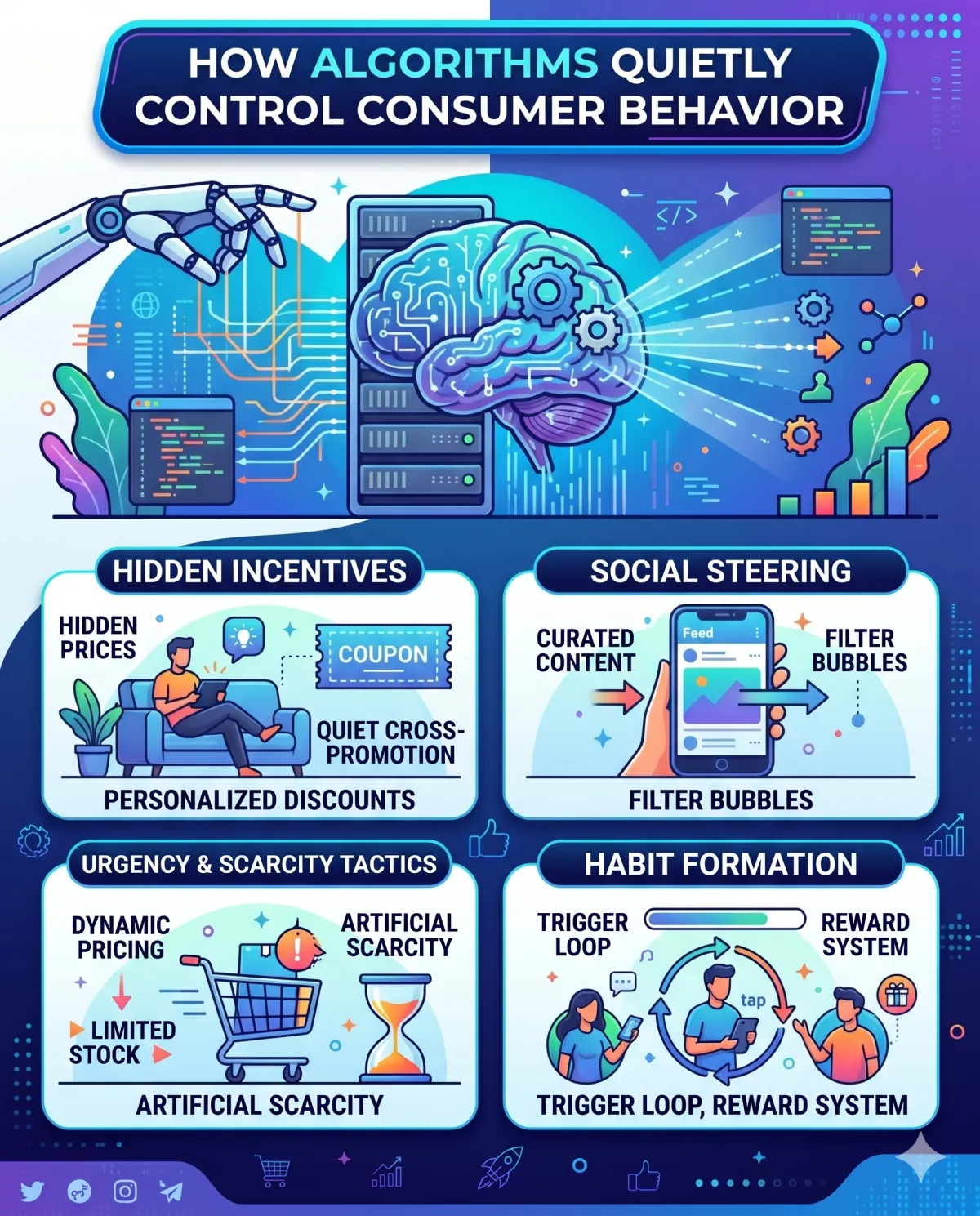
How Algorithms Quietly Control Consumer Behavior
How Algorithms Quietly Control Consumer Behavior
Most consumers believe they make independent decisions online.
They believe they choose what content to watch, which products to buy, what opinions to form, and which trends to follow. But in 2026, many of those decisions are increasingly shaped long before users consciously make them.
Behind nearly every digital platform sits an algorithm designed to predict, influence, and optimize behavior.
These systems determine:
What people see
What they ignore
What captures attention
What becomes popular
What consumers eventually purchase
Algorithms are no longer just organizational tools. They have become behavioral influence systems operating at enormous scale.
And most consumers barely notice their impact.
The Internet No Longer Shows Everything
In the early days of the internet, digital platforms functioned more like open libraries. Users searched for information manually and browsed content chronologically.
That model no longer exists.
Today, platforms filter almost everything through recommendation systems. Consumers are not seeing the internet itself—they are seeing personalized versions of it.
Every major platform now relies heavily on algorithms:
TikTok
Instagram
YouTube
Amazon
Netflix
Spotify
Google
Facebook
X
LinkedIn
These systems decide which content receives visibility and which content disappears.
The result is that algorithms quietly shape digital reality for billions of people every day.
Algorithms Optimize for Attention, Not Necessarily Truth
One of the most important things to understand is that algorithms are not neutral.
Their primary goal is usually engagement.
Platforms make money when users stay active longer, click more often, watch more content, and interact more frequently. Because of this, recommendation systems are optimized heavily around attention retention.
The algorithm asks:
What keeps users scrolling?
What triggers emotional reactions?
What increases viewing time?
What generates interaction?
This creates powerful behavioral effects.
Content that is emotionally intense, controversial, entertaining, fear-driven, or highly stimulating often performs better because it keeps attention longer.
Over time, consumers are gradually pushed toward content that maximizes engagement—even if they never intentionally searched for it.
The TikTok Effect Changed Consumer Behavior Forever
Few platforms demonstrated algorithmic influence more clearly than TikTok.
Unlike older social media platforms that relied heavily on follower networks, TikTok built its growth around predictive recommendation systems. The “For You” feed became one of the most powerful attention engines ever created.
Users no longer needed to follow creators to consume their content. The algorithm simply learned behavior patterns rapidly and optimized recommendations in real time.
This changed consumer expectations permanently.
People became accustomed to:
Instant entertainment
Hyper-personalized feeds
Rapid trend cycles
Continuous novelty
Passive content discovery
Consumers stopped actively searching for content and started allowing algorithms to deliver it automatically.
That shift significantly increased the influence platforms have over attention and purchasing behavior.
Algorithms Shape What Consumers Buy
Recommendation systems now influence shopping behavior at nearly every stage of the customer journey.
Consumers are guided through:
Product recommendations
Personalized advertisements
Suggested purchases
Trending item lists
Influencer integrations
Behavioral targeting systems
On platforms like Amazon, consumers often purchase products they never originally intended to search for because algorithms continuously surface related options based on browsing history and predictive data.
Social media platforms amplify this even further.
Many viral products become successful not because of traditional advertising campaigns, but because algorithms repeatedly expose users to them until familiarity creates interest.
Repeated exposure builds trust.
And trust increases purchasing likelihood.
The Psychology Behind Algorithmic Influence
Algorithms are effective because they align closely with human psychology.
Humans naturally respond to:
Social proof
Repetition
Emotional stimulation
Novelty
Personal relevance
Fear of missing out
Convenience
Recommendation systems exploit these tendencies extremely efficiently.
For example:
If consumers repeatedly see a product trending online, they begin perceiving it as culturally important—even if the trend itself was artificially amplified by engagement systems.
This creates a feedback loop:
Algorithms push content
Visibility creates popularity
Popularity creates social validation
Social validation increases engagement
Increased engagement strengthens algorithmic distribution
Consumers then interpret algorithmic popularity as genuine cultural demand.
Personalization Increased Algorithmic Power
Modern algorithms are far more sophisticated than earlier recommendation systems.
They no longer rely only on simple demographics or keyword matching. Instead, AI systems analyze:
Watch time
Pause behavior
Scroll speed
Purchase history
Engagement patterns
Search behavior
Emotional reaction signals
Interaction timing
This allows platforms to create extremely personalized digital experiences.
The result is that no two consumers experience the internet the same way anymore.
Each person exists inside a customized algorithmic environment designed specifically to maximize their engagement.
That level of personalization increases behavioral influence dramatically because recommendations feel personally relevant rather than broadly advertised.
Algorithms Quietly Shape Culture
One of the most overlooked effects of algorithms is their influence on culture itself.
Algorithms increasingly determine:
Which songs become popular
Which creators gain influence
Which fashion trends spread
Which opinions gain visibility
Which businesses grow rapidly
Which topics dominate conversation
This means platforms are no longer simply reflecting culture.
They are actively shaping it.
A trend that gains early algorithmic momentum can rapidly become culturally dominant because visibility itself creates participation.
Consumers often mistake algorithmic amplification for organic popularity.
But many modern trends are heavily accelerated—or even created—by recommendation systems.
Why Consumers Rarely Notice the Influence
Algorithms are especially powerful because they operate invisibly.
Consumers do not usually feel manipulated because recommendations appear seamless and personalized. The experience feels natural.
People assume:
“I discovered this myself.”
In reality, platforms heavily influence what users are even able to discover in the first place.
The most effective influence systems are often the least noticeable.
And algorithms excel at subtle behavioral guidance because they shape options before decisions are consciously made.
Businesses Now Design Content for Algorithms First
This shift has transformed marketing completely.
Businesses no longer create content solely for human audiences. They create content designed to perform well inside recommendation systems.
Modern content strategy increasingly focuses on:
Retention optimization
Engagement triggers
Shareability
Emotional hooks
Watch-time maximization
Trend compatibility
The algorithm becomes the first audience.
Humans become the second.
This creates an environment where brands compete not just for consumer attention, but for algorithmic favor.
The Rise of Behavioral Prediction
Perhaps the most powerful aspect of modern algorithms is predictive behavior modeling.
Platforms increasingly attempt to predict:
What consumers will click
What they will buy
What emotions they will respond to
Which content keeps them engaged
Which products they are likely to purchase next
The better these systems become at prediction, the more influence they gain over behavior itself.
Consumers often interpret personalized recommendations as convenience. But recommendation quality also increases dependency on algorithmic guidance.
People begin outsourcing discovery and decision-making to machines.
The Ethical Questions Around Algorithmic Control
As algorithms gain more influence, ethical concerns continue growing.
Critics increasingly question:
How much behavioral influence platforms should have
Whether algorithms encourage unhealthy consumption habits
How misinformation spreads through engagement optimization
The psychological impact of hyper-personalized feeds
The effects of constant stimulation on attention spans
Governments and regulators are beginning to examine these systems more closely, but the technology continues evolving rapidly.
And for businesses, algorithms remain too valuable to ignore.
Can Consumers Escape Algorithmic Influence?
Completely escaping algorithmic influence is becoming increasingly difficult because recommendation systems now dominate most digital experiences.
However, awareness matters.
Consumers who understand how algorithms operate can make more intentional decisions about:
Content consumption
Shopping behavior
Social media habits
Information sources
Online engagement patterns
The first step toward reducing algorithmic control is recognizing that it exists.
Most influence today happens quietly.
Conclusion
Algorithms have become some of the most powerful invisible forces shaping modern consumer behavior.
They influence what people watch, buy, discuss, believe, and prioritize online—often without users fully realizing it. What began as recommendation technology has evolved into a global behavioral guidance system powered by AI, engagement optimization, and predictive analytics.
In 2026, consumers are no longer simply browsing the internet.
They are navigating algorithmically constructed realities tailored specifically to maximize attention and influence behavior.
For businesses, understanding algorithms is no longer optional. It is central to marketing, growth, and visibility.
And for consumers, the challenge is becoming increasingly clear:
The biggest influence online is often the one nobody notices.
