
Understanding Benchmark vs. Momentum Rankings on BusinessRate
Understanding Benchmark vs. Momentum Rankings on BusinessRate
In today’s digital-first world, every business owner knows that online reputation and customer feedback are more than just vanity metrics, they’re critical indicators of business health and growth potential. At BusinessRate, we provide comprehensive ranking systems to help businesses measure and understand their performance in the marketplace. Two of the most important metrics in our system are Benchmark Ranking and Momentum Ranking. While these metrics are related, they each serve a distinct purpose in evaluating your business performance.
What is the Benchmark Score?
The Benchmark Score is a comprehensive performance metric that goes beyond simple star ratings. It evaluates your business across multiple dimensions, providing an easy-to-understand score that reflects how you perform relative to your competitors in the same industry and geographic area.
Why the Benchmark Score Matters
Competitive Positioning
Your Benchmark Score becomes meaningful when compared to competitors. By ranking businesses within the same category and local market, you can see exactly where you stand and identify areas for improvement.Same Category Comparison
Benchmark Rankings compare your business only to others in your exact industry category. For example, Italian restaurants in Mesa, AZ, compete only against other Italian restaurants in the same area.Geographic Boundaries
Our rankings are specific to your city or local service area. This ensures fair and relevant comparisons that reflect the local market dynamics.Fair Competition
Every business is measured using the same scoring methodology, ensuring a level playing field for all participants.
Components of the Benchmark Score
The Benchmark Score combines three key components:
Endurance Score (60% Weight)
This measures your historical performance, considering every review your business has ever received. It rewards long-term consistency and demonstrates your established reputation to potential customers.Momentum Score (33% Weight)
Representing one-third of the total score, this metric captures your recent performance trends and customer satisfaction over the last 90 days. It reflects your current growth and engagement in the market.Review Quality Score (7% Weight)
Review depth and authenticity are critical for trust. This component evaluates the quality of reviews, ensuring that detailed and genuine feedback is valued over sheer quantity.
The combination of these three components produces a Benchmark Score on a simple 0-300 scale, providing a clear snapshot of your overall business performance.
What is the Momentum Score?
While the Benchmark Score reflects both historical and recent performance, the Momentum Score is a snapshot of your business’s current trajectory. It focuses on recent customer feedback, giving you insight into your short-term performance trends.
Why Momentum Matters
90-Day Performance Window
The Momentum Score looks at reviews from the past three months. This window ensures that your score reflects your current market position rather than outdated performance.Volume & Sentiment Analysis
Momentum not only measures the number of reviews you receive but also analyzes the sentiment behind them. Positive trends signal growing customer satisfaction, while negative trends highlight areas needing attention.Competitive Benchmarking
Just like the Benchmark Score, the Momentum Score compares your recent performance against other businesses in your category and location. This real-time analysis shows you how you stack up against the competition.
Essentially, while the Benchmark Score tells you how you’ve performed over time, the Momentum Score tells you how you’re performing right now.
Key Differences Between Benchmark and Momentum Rankings
Understanding the distinction between these two metrics is crucial for interpreting your BusinessRate rankings accurately.
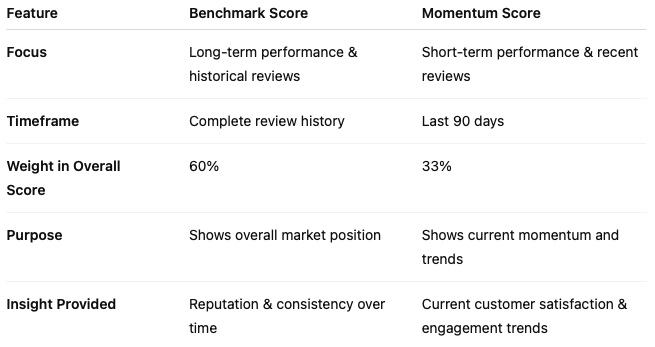
How Businesses Can Use These Metrics
Identify Strengths and Weaknesses
By examining both Benchmark and Momentum Scores, business owners can identify areas of long-term excellence and recent opportunities for improvement.Track Growth Over Time
The Momentum Score allows you to see the immediate impact of new initiatives, marketing campaigns, or service changes, while the Benchmark Score shows the cumulative effect of your efforts.Enhance Local Reputation
Businesses can use these insights to strategically improve customer experience, address negative feedback, and capitalize on positive trends.Benchmark Against Competitors
Both metrics allow businesses to compare their performance against peers in the same industry and area, giving actionable insight into competitive positioning.
Conclusion
The Benchmark Score and Momentum Score are complementary tools in the BusinessRate ranking system. Benchmark Rankings give you a holistic view of your business’s historical and overall performance, while Momentum Rankings provide real-time insight into your recent trends and customer satisfaction. Together, these scores equip businesses with the data they need to improve performance, engage customers, and grow in their local market.
Understanding the difference between these rankings isn’t just academic—it’s practical. When used strategically, these metrics can help businesses identify growth opportunities, build long-term reputation, and make data-driven decisions that drive both customer loyalty and competitive advantage.
By leveraging both Benchmark and Momentum insights, your business can confidently navigate the competitive landscape, stay ahead of market trends, and continually enhance the customer experience.
