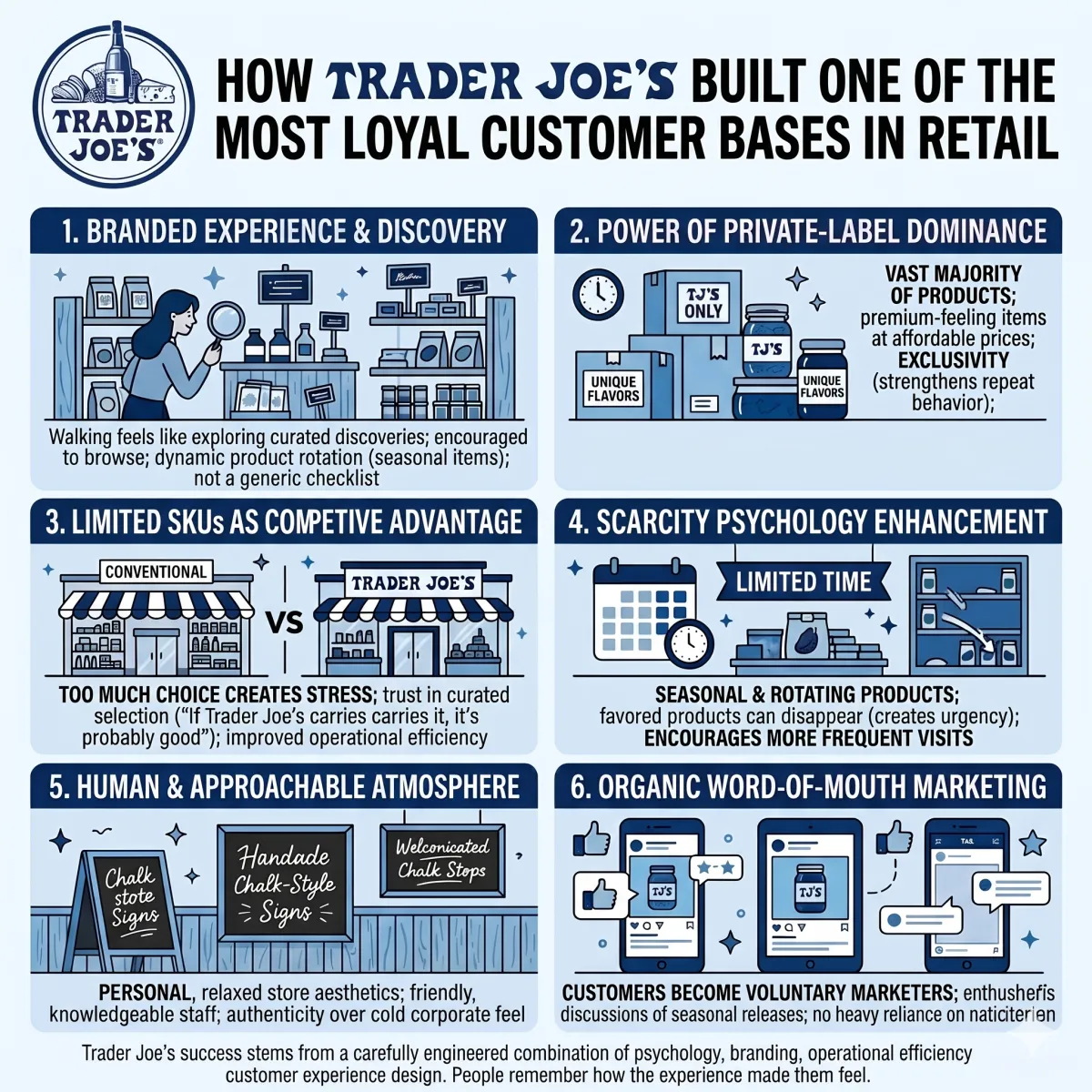
How Trader Joe’s Built One of the Most Loyal Customer Bases in Retail
How Trader Joe’s Built One of the Most Loyal Customer Bases in Retail
Few grocery chains in the United States inspire the kind of customer loyalty that Trader Joe’s has built over the years.
For many shoppers, Trader Joe’s is not simply a grocery store, it is an experience, a routine, and in some cases, even part of their personal identity. Customers regularly go out of their way to shop there, enthusiastically recommend products online, and actively discuss seasonal releases across social media platforms.
What makes Trader Joe’s especially interesting is that its success did not come from following traditional grocery industry strategies.
The company does not rely heavily on national advertising.
Its stores are smaller than many competitors.
Its product selection is intentionally limited.
And many of its most popular items disappear without warning.
Yet despite all of this, or perhaps because of It, Trader Joe’s has created one of the strongest customer loyalty ecosystems in modern retail.
The secret lies in a carefully engineered combination of psychology, branding, operational efficiency, and customer experience design.
Trader Joe’s Built a Brand Around Discovery
Most grocery stores are designed for efficiency and predictability.
Trader Joe’s took the opposite approach.
Walking through a Trader Joe’s location often feels less like completing a task and more like exploring curated discoveries. Customers are encouraged to browse rather than simply shop from a list.
This experience is intentional.
The company rotates products frequently, introduces seasonal items consistently, and limits inventory in ways that create a sense of novelty every time customers visit.
Consumers never fully know what they might find.
That uncertainty creates excitement.
Instead of shopping becoming repetitive, Trader Joe’s transforms grocery shopping into something closer to entertainment.
The Power of Private-Label Dominance
One of Trader Joe’s most important business strategies is its overwhelming reliance on private-label products.
Unlike traditional grocery stores filled with competing national brands, Trader Joe’s sells the vast majority of products under its own label.
This provides several major advantages.
First, private-label products allow Trader Joe’s to control pricing more effectively. Without paying for massive national brand marketing campaigns, the company can offer premium-feeling products at relatively affordable prices.
Second, it creates exclusivity.
Customers cannot simply buy Trader Joe’s products elsewhere. If shoppers fall in love with a specific frozen meal, snack, sauce, or dessert, they must return to Trader Joe’s to purchase it again.
That exclusivity strengthens repeat customer behavior.
Third, private-label dominance simplifies decision-making.
Traditional grocery stores often overwhelm consumers with dozens of nearly identical options. Trader Joe’s intentionally reduces choice complexity by curating fewer products.
Ironically, having fewer options often improves the shopping experience because consumers experience less decision fatigue.
Limited SKUs Became a Competitive Advantage
Most major grocery chains carry tens of thousands of products.
Trader Joe’s carries significantly fewer.
At first glance, this seems counterintuitive. Conventional retail wisdom suggests more variety attracts more customers. But Trader Joe’s recognized something important about consumer psychology:
Too much choice can create stress.
By offering a curated inventory instead of endless options, Trader Joe’s simplifies shopping while reinforcing trust in its product selection.
Customers begin believing:
“If Trader Joe’s carries it, it’s probably good.”
That trust becomes extremely valuable.
Instead of customers evaluating dozens of competing brands, Trader Joe’s essentially pre-selects products on their behalf.
This creates a more relaxed and confident shopping experience.
Operationally, limited SKUs also improve efficiency:
Faster inventory turnover
Simplified supply chains
Stronger supplier relationships
Lower operational complexity
Higher sales per product
The strategy benefits both the customer and the business simultaneously.
Scarcity Psychology Keeps Customers Engaged
Trader Joe’s also uses scarcity exceptionally well.
Seasonal items, rotating products, and discontinued favorites create a subtle but powerful sense of urgency.
Customers know that:
Certain products may only appear temporarily
Seasonal items may sell out quickly
Favorite products can disappear permanently
This uncertainty encourages more frequent store visits and impulse purchases.
Scarcity increases emotional attachment.
Consumers often become highly invested in limited Trader Joe’s products because temporary availability makes them feel more valuable and memorable.
This is one reason Trader Joe’s products generate so much online discussion. Customers actively share:
Product discoveries
Seasonal returns
Favorite items
“Must-buy” recommendations
Discontinued product complaints
The scarcity itself fuels community engagement and organic marketing.
Store Atmosphere Feels Human Instead of Corporate
Another major factor behind Trader Joe’s loyalty is store atmosphere.
Many large grocery chains feel highly corporate, automated, and transactional. Trader Joe’s intentionally creates a more personal and approachable environment.
The stores use:
Handwritten signs
Themed decorations
Smaller layouts
Friendly staff interactions
Casual branding language
Relaxed store aesthetics
These design choices create warmth and personality.
Customers often describe Trader Joe’s as feeling more “human” than competitors.
That emotional perception matters more than many businesses realize.
Consumers increasingly prefer brands that feel relatable and authentic rather than cold and corporate.
Employees Became Part of the Brand Experience
Trader Joe’s employees play a significant role in customer loyalty.
The company is well-known for emphasizing friendliness, product knowledge, and positive interactions. Staff members frequently engage customers in casual conversations, offer recommendations, and create a welcoming environment.
Importantly, these interactions usually feel less scripted than traditional retail customer service.
That authenticity strengthens emotional connection.
Consumers remember how brands make them feel, not just what they sell.
Positive employee interactions turn routine shopping trips into enjoyable experiences, increasing long-term loyalty.
Trader Joe’s Mastered “Affordable Premium” Positioning
One of Trader Joe’s smartest positioning strategies is what could be described as “accessible premium.”
The company successfully makes customers feel like they are buying unique, specialty, or gourmet products without luxury-level pricing.
Many Trader Joe’s items feel elevated compared to standard grocery products:
International flavors
Creative frozen meals
Specialty snacks
Organic options
Trend-focused foods
Unique desserts
This creates a psychological feeling of smart spending.
Customers feel they are discovering high-quality products at unusually good value.
That emotional combination, premium perception with affordable pricing, is extremely powerful in retail.
The Brand Benefits From Organic Word-of-Mouth Marketing
Trader Joe’s rarely relies on aggressive traditional advertising campaigns.
Instead, much of its growth comes from word-of-mouth marketing and social media enthusiasm.
Customers naturally share Trader Joe’s content online because the products are:
Visually interesting
Seasonal
Unique
Limited
Trend-friendly
Conversation-worthy
This turns customers into voluntary marketers.
In many ways, Trader Joe’s operates more like a lifestyle brand than a grocery chain.
Consumers enjoy talking about the brand because it reflects taste, discovery, and participation in a shared shopping culture.
Trader Joe’s Avoided Overexpansion
Unlike many large retail chains, Trader Joe’s has historically expanded more cautiously.
This slower expansion strategy helps preserve:
Product quality
Store culture
Operational consistency
Brand identity
Customer experience standards
Scarcity exists at the brand level as well.
Because Trader Joe’s locations are not as aggressively widespread as some competitors, the stores maintain a sense of uniqueness and intentionality.
Overexpansion often weakens brand identity.
Trader Joe’s largely avoided that trap.
Why Consumers Feel Emotionally Connected to Trader Joe’s
Perhaps the most important factor behind Trader Joe’s loyalty is emotional connection.
The brand successfully combines:
Discovery
Familiarity
Scarcity
Value
Personality
Community
Trust
Very few retailers manage to balance all of these simultaneously.
Customers often develop routines and emotional attachments around Trader Joe’s products because the experience feels enjoyable rather than purely functional.
The store becomes associated with positive emotions.
And emotional loyalty is significantly stronger than transactional loyalty.
The Bigger Retail Lesson
Trader Joe’s success reveals something important about modern consumer behavior:
Consumers are no longer only shopping for products.
They are shopping for experiences, identity, emotion, and simplicity.
In a world overloaded with options, brands that reduce friction and create emotional engagement gain enormous advantages.
Trader Joe’s understood that efficiency alone does not build loyalty.
Experience does.
Conclusion
Trader Joe’s built one of the most loyal customer bases in retail by doing many things differently from traditional grocery chains.
Instead of maximizing product quantity, it focused on curation.
Instead of relying heavily on advertising, it built word-of-mouth momentum.
Instead of creating purely transactional stores, it designed emotionally engaging shopping experiences.
Its private-label strategy, scarcity psychology, store atmosphere, and customer-focused culture all work together to create a retail ecosystem that feels unique, approachable, and highly addictive to consumers.
In many ways, Trader Joe’s succeeded because it recognized something many retailers overlooked:
People do not always remember the exact products they bought.
But they remember how the experience made them feel.
