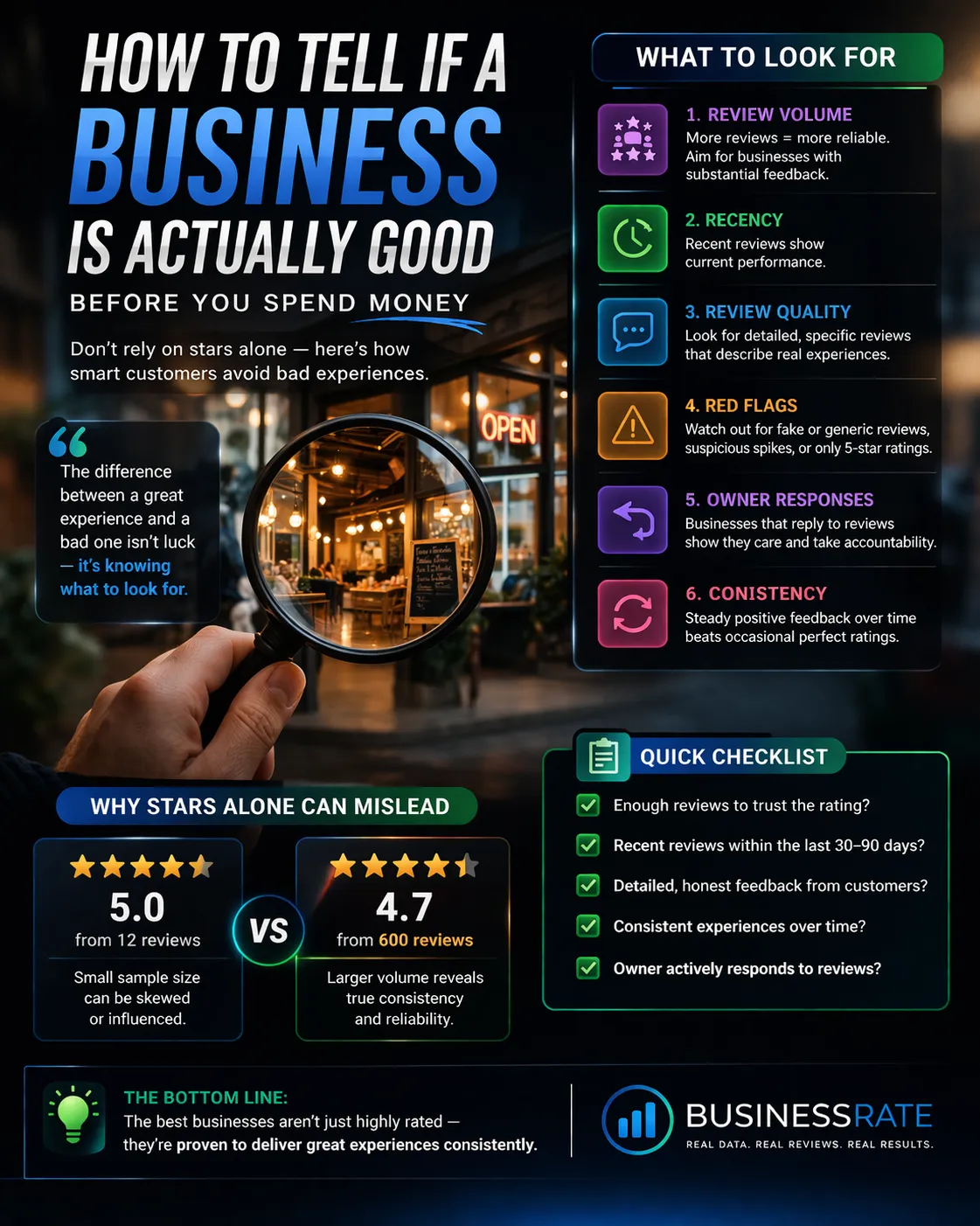
How to Tell If a Business Is Actually Good (Before You Spend Money)
How to Tell If a Business Is Actually Good (Before You Spend Money)
Don’t rely on stars alone, here’s how smart customers avoid bad experiences.
“The difference between a great experience and a bad one isn’t luck — it’s knowing what to look for.”
We’ve all been there. You search for a business, see a high rating, and assume you’re making a safe choice. But then the experience doesn’t match the expectation. The service is inconsistent, the quality isn’t what you hoped for, or something just feels off.
The truth is, star ratings alone don’t tell the full story. While they can be helpful, they often hide the details that actually determine whether a business is worth your time and money.
If you want to consistently choose the right businesses — whether it’s a restaurant, service provider, or local company — you need to know what signals actually matter.
This guide breaks down exactly how to tell if a business is truly good before you commit.
Why Star Ratings Can Be Misleading
At first glance, a 4.8 or 5-star rating seems like a guarantee of quality. But not all ratings are created equal.
A business with a perfect 5.0 rating might only have a handful of reviews. Another business might have a 4.6 rating — but with hundreds or even thousands of customers backing it up.
Which one is more reliable?
In most cases, the business with more reviews provides a clearer, more accurate picture of what you can expect. Star ratings are averages, and averages can be skewed — especially when the sample size is small.
Early reviews often come from friends, family, or especially motivated customers. This can inflate ratings and make a business appear stronger than it actually is.
👉Takeaway:A high rating doesn’t automatically mean a better business — context matters.
Review Volume Tells a Bigger Story
One of the most overlooked factors when evaluating a business is review volume.
Think of it this way:
5.0 stars from 12 reviews
4.7 stars from 600 reviews
The second business has been tested by far more customers. It has proven consistency over time, across different situations, expectations, and experiences.
High review volume means:
More data
Less bias
A stronger indicator of real performance
Low review volume, on the other hand, leaves too much room for uncertainty.
👉Rule of thumb:The more reviews a business has, the more you can trust the rating.
Watch for Red Flags in Reviews
Not all reviews are honest, and not all are helpful. Learning to spot red flags can save you from making a bad decision.
Here are some things to watch for:
🚩 Overly Generic Reviews
If multiple reviews say things like:
“Great service!”
“Amazing experience!”
…but don’t include any detail, they may not be reliable.
🚩 Repetitive Language
If reviews sound nearly identical, they may have been prompted or influenced.
🚩 Sudden Spikes in Reviews
A large number of reviews appearing in a short time period can sometimes indicate artificial boosting.
🚩 No Negative Feedback at All
No business is perfect. A complete lack of critical reviews can be a sign that feedback is being filtered or managed.
👉Takeaway:Authentic reviews are detailed, varied, and balanced.
Recency Matters More Than You Think
A business might have great reviews — but are they recent?
Customer experience can change over time. Staff turnover, management changes, or declining standards can all impact quality.
A business that was excellent two years ago may not be today.
When evaluating a business, check:
Are there recent reviews within the last 30–90 days?
Are customers still having positive experiences now?
Consistency over time is one of the strongest indicators of a reliable business.
👉Takeaway:Don’t just look at how good a business was — look at how good it is right now.
Look at the Quality of Feedback
The best reviews don’t just rate a business — they describe the experience.
High-quality reviews often include:
Specific details about service or products
Names of staff members
Before-and-after comparisons
Honest pros and cons
These reviews are much harder to fake and provide real insight into what you can expect.
Low-quality reviews, on the other hand, tend to be vague and uninformative.
👉Takeaway:Detailed reviews are more trustworthy than short, generic ones.
Pay Attention to Owner Responses
One of the most underrated signals of a good business is how the owner responds to reviews.
Look for businesses that:
Respond to both positive and negative feedback
Address concerns professionally
Show appreciation for customers
This demonstrates accountability and a commitment to customer satisfaction.
On the flip side, businesses that ignore reviews — especially negative ones — may not prioritize customer experience.
👉Takeaway:Engagement shows that a business cares about its reputation.
Consistency Is the Real Indicator of Quality
A truly great business doesn’t rely on a few standout reviews — it delivers consistent results over time.
Consistency shows up as:
Steady positive feedback
Reliable service experiences
Minimal extreme swings between great and terrible reviews
If you see a pattern of mixed experiences, it may indicate inconsistency in quality.
👉Takeaway:The best businesses aren’t occasionally great — they’re reliably great.
A Simple Checklist Before You Choose a Business
Before you spend money, run through this quick checklist:
✔️ Does the business have a strong number of reviews?
✔️ Are the reviews recent?
✔️ Are customers leaving detailed, authentic feedback?
✔️ Is the rating supported by consistent experiences?
✔️ Does the owner engage with reviews?
If the answer is yes across the board, you’re likely making a solid choice.
Why This Matters More Than Ever
Today, more people rely on online reviews than ever before. But as reviews become more influential, they also become easier to manipulate.
That means the responsibility shifts to the consumer to look deeper.
Understanding how to evaluate a business properly helps you:
Avoid wasting money
Reduce risk
Find consistently great experiences
It also rewards businesses that genuinely deliver quality — not just those that look good on the surface.
Make Smarter Decisions Every Time
Choosing a great business isn’t about luck — it’s about knowing what signals to trust.
Star ratings are just the starting point. The real story lies in the data behind them: volume, consistency, recency, and authenticity.
The next time you’re deciding where to spend your money, take a few extra moments to look deeper.
👉 Because the best decisions aren’t based on what looks good — they’re based on what’s proven to be good.
