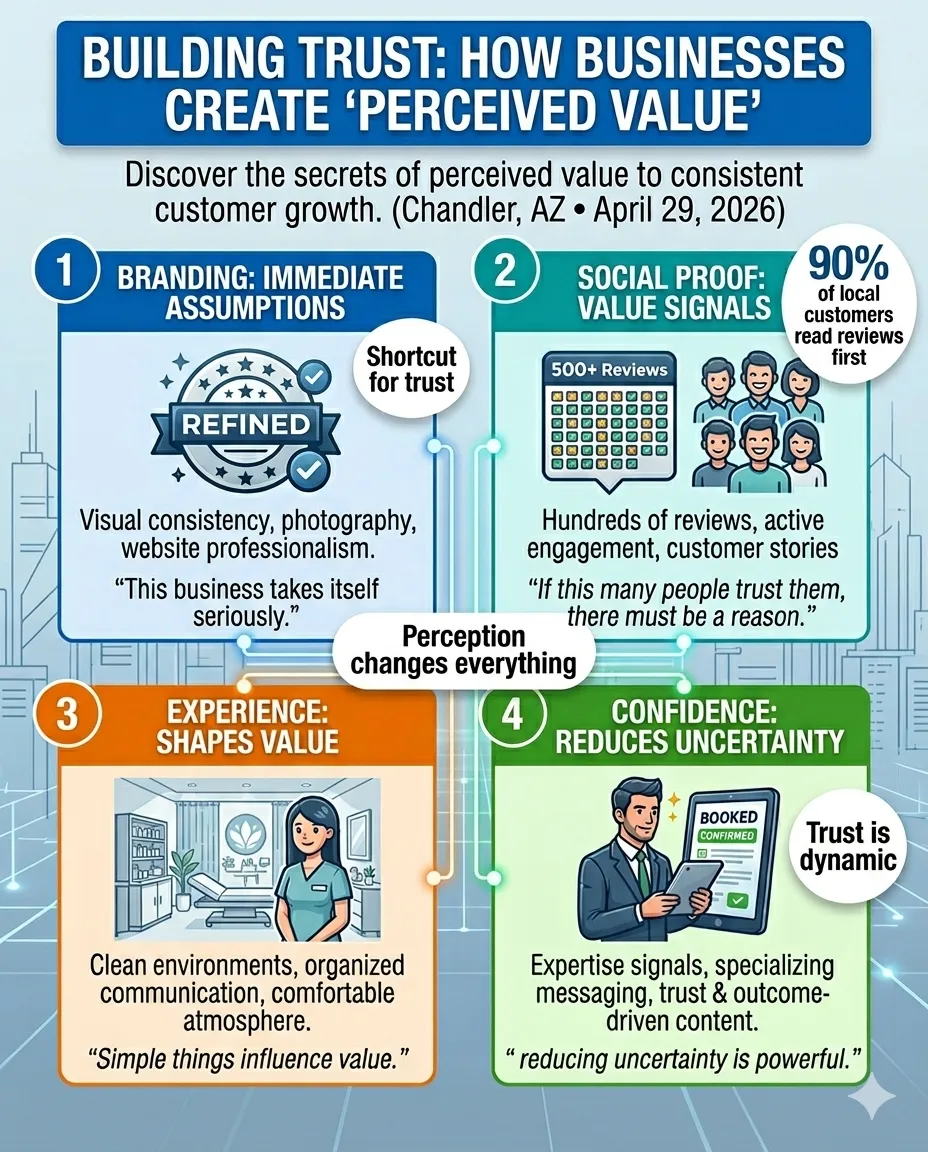
How Businesses Create “Perceived Value”
How Businesses Create “Perceived Value”
Why will someone spend $7 on a coffee at one café but hesitate to spend $2 somewhere else?
Why do customers willingly pay premium prices for certain brands even when cheaper alternatives exist?
And why do some businesses instantlyfeelmore valuable the moment you walk through the door?
The answer is perceived value.
In business, customers are rarely paying only for the product itself. They’re paying for the experience, the trust, the feeling, the convenience, the status, and the confidence attached to it.
That means value is not always created by what somethingis.
It’s often created by what customersbelieve it is worth.
The businesses that understand this don’t compete only on price. They compete on perception.
And perception changes everything.
What Is Perceived Value?
Perceived value is the customer’s overall impression of whether a product or service is worth the price being charged.
It’s emotional before it’s logical.
Customers constantly ask themselves questions like:
Does this feel trustworthy?
Does this seem premium?
Will this experience be worth it?
Do other people value this business?
Does this brand make me feel confident?
The interesting part is that perceived value is often builtbeforethe customer ever buys anything.
The website.
The reviews.
The branding.
The environment.
The presentation.
The social proof.
All of it creates expectations.
And expectations heavily influence buying decisions.
Why Perception Matters More Than Price
Most businesses assume lower prices automatically attract more customers.
But that’s not always true.
In many industries, lower pricing can actually reduce trust.
Customers often associate:
Higher prices with higher quality
Premium branding with professionalism
Strong reputation with reliability
Scarcity with desirability
That’s why luxury brands rarely compete on discounts.
They compete on perception.
Think about brands like Apple, Rolex, Tesla, or Louis Vuitton. Customers are not only purchasing functionality — they’re purchasing identity, experience, and emotional positioning.
The same principle applies to local businesses too.
A med spa, coffee shop, salon, law firm, or contractor that looks polished and trusted will often outperform cheaper competitors simply because customersfeel safer choosing them.
Perceived value reduces uncertainty.
And customers pay for certainty.
Branding Creates Immediate Assumptions
Customers form opinions faster than most businesses realize.
In seconds, people judge:
Logo quality
Website professionalism
Visual consistency
Social media presence
Photography
Tone of messaging
These signals create an instant impression of quality.
Even before a customer reads a review or makes a phone call, they’ve already started deciding whether the business feels:
premium,
trustworthy,
outdated,
cheap,
professional,
or unreliable.
This is why branding matters far beyond aesthetics.
Good branding acts like a shortcut for trust.
It tells customers:
“This business takes itself seriously.”
And when businesses look more organized, customers assume the experience will also be more organized.
Social Proof Is One of the Strongest Value Signals
Humans naturally look to others when making decisions.
That’s why reviews, testimonials, ratings, and popularity matter so much.
When customers see:
hundreds of positive reviews,
active engagement,
consistent customer experiences,
or people recommending a business,
they feel safer making a purchase.
This is called social proof.
And it dramatically increases perceived value.
A business with 500 reviews and strong customer interaction often feels more trustworthy than a business with little online presence — even if the actual service quality is similar.
Customers assume:
“If this many people trust them, there must be a reason.”
This is also why busy businesses attract even more customers.
People are naturally drawn toward businesses that appear popular, validated, and in demand.
Popularity itself becomes part of the value.
Experience Shapes Value More Than Most Businesses Think
Customers remember how businesses make them feel.
That feeling often becomes more important than the product itself.
Two businesses can sell nearly identical products, but the experience can completely change customer perception.
Simple things influence value:
Clean environments
Friendly staff
Fast response times
Organized communication
Comfortable atmosphere
Packaging and presentation
Ease of booking or checkout
Customers associate smooth experiences with professionalism.
And professionalism increases perceived value.
This is why high-end hotels, restaurants, and luxury brands obsess over details.
The details create emotion.
And emotion creates value.
Scarcity and Exclusivity Increase Demand
One of the oldest psychological strategies in business is scarcity.
People naturally value things more when they believe access is limited.
This is why businesses use:
limited-time offers,
exclusive memberships,
appointment-only access,
seasonal products,
or waitlists.
Scarcity creates urgency.
Urgency increases emotional decision-making.
And emotional decision-making increases perceived value.
Customers often assume:
“If it’s difficult to get, it must be valuable.”
Luxury brands use this strategy constantly.
But local businesses can use it too.
Even simple messaging like:
“Limited availability this month”
“Only accepting a few new clients”
“Appointments filling quickly”
can increase perceived demand and elevate positioning.
Pricing Itself Influences Perception
Many businesses unintentionally lower their own perceived value through pricing.
When prices are too low, customers sometimes become suspicious.
They ask:
Why is this cheaper?
Is the quality lower?
Are they inexperienced?
Is something missing?
This doesn’t mean businesses should overcharge.
But it does mean pricing communicates positioning.
Higher pricing often signals:
expertise,
confidence,
specialization,
and professionalism.
That’s why premium businesses rarely focus their marketing on “cheap.”
Instead, they focus on:
outcomes,
experience,
quality,
trust,
and transformation.
Customers paying premium prices want reassurance that the experience will justify the investment.
And when the branding, reviews, communication, and presentation all align, customers are far more willing to spend.
Consistency Builds Long-Term Value
One great experience can attract a customer.
Consistency keeps them.
The businesses with the strongest perceived value usually create consistent expectations across everything they do.
That means:
consistent branding,
consistent customer service,
consistent quality,
consistent communication,
and consistent reputation.
When customers know what to expect, trust increases.
And trust is one of the most valuable assets a business can have.
This is why inconsistent businesses struggle even when they occasionally deliver excellent service.
Customers don’t buy based only on possibility.
They buy based on predictability.
Businesses that consistently deliver positive experiences create emotional reliability — and emotional reliability increases value over time.
Reputation Is the Foundation of Perceived Value
At the center of perceived value is reputation.
Reputation influences:
first impressions,
trust,
conversions,
customer confidence,
and pricing power.
A strong reputation allows businesses to:
attract higher-quality customers,
charge more confidently,
reduce customer hesitation,
and compete beyond price alone.
Customers often decide whether a business feels “worth it” before they ever speak to someone directly.
That decision is heavily influenced by reputation signals online.
That’s why:
reviews,
rankings,
testimonials,
customer photos,
response quality,
and public perception
matter more than ever.
In today’s market, businesses are constantly being evaluated.
Not just by people — but by algorithms too.
Google, AI search systems, and recommendation platforms all analyze trust signals when deciding what businesses deserve visibility.
That means perceived value now impacts both:
customer behavior,
and online discoverability.
The Most Valuable Businesses Sell Confidence
At the end of the day, customers are buying confidence.
Confidence that:
the product will work,
the experience will be smooth,
the business is trustworthy,
and the money will feel well spent.
Businesses that successfully create perceived value reduce uncertainty.
And reducing uncertainty is one of the most powerful forms of marketing.
That’s why the highest-performing brands in the world focus so heavily on:
presentation,
trust,
reputation,
consistency,
and emotional experience.
They understand something many businesses miss:
Customers don’t simply buy products.
They buy the story, the feeling, the confidence, and the perception attached to them.
Final Thoughts
Perceived value is not manipulation.
It’s the result of building trust, creating consistency, and presenting your business in a way that reflects the quality of what you actually offer.
The businesses that win long term are rarely the cheapest.
They’re the ones that:
feel trustworthy,
look professional,
deliver consistent experiences,
and create emotional confidence in the customer journey.
Because in modern business, perception influences almost everything:
clicks,
conversions,
loyalty,
referrals,
pricing power,
and growth.
The businesses that understand perceived value don’t just sell products or services better.
They become brands customers remember.
