How Much the World’s Biggest Brands Make Per Year, Day, Minute, and Second
How Much the World’s Biggest Brands Make Per Year, Day, Minute, and Second
Most people interact with massive global brands every single day without ever stopping to think about the scale behind them.
A quick coffee run, a grocery trip, a movie streamed at home, a subscription renewed automatically, or a pair of shoes ordered online all feel like small, ordinary transactions. They are so routine that they almost disappear into the background of daily life.
But behind those everyday purchases are companies generating billions of dollars at a pace that is difficult to fully comprehend. These are not just businesses operating in markets. They are global systems continuously converting human behavior into revenue.
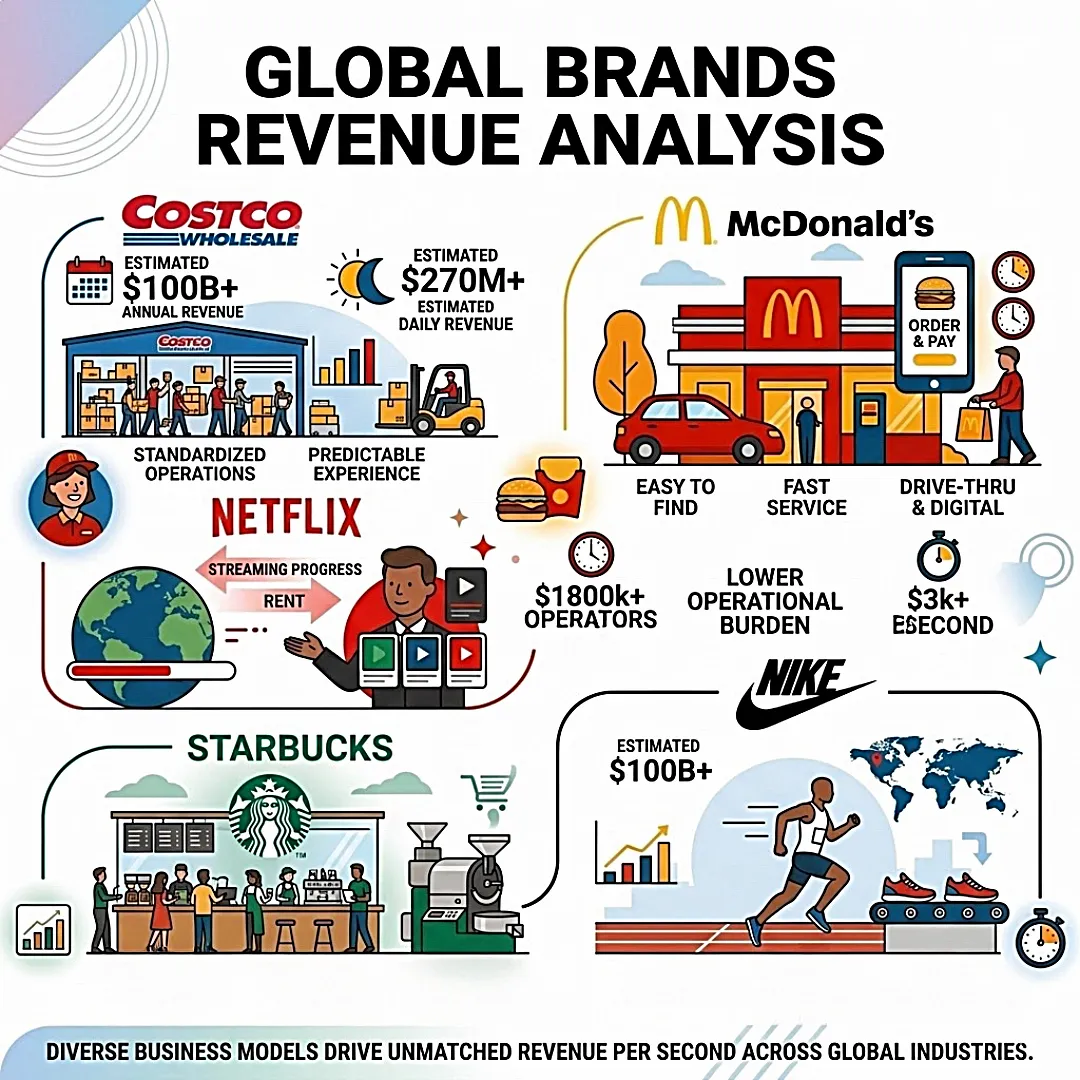
To put that scale into perspective, we broke down how much some of the world’s biggest brands earn per year, per day, per minute, and per second. Once you start looking at time in this way, business stops feeling static and starts feeling like a constant flow of money moving through global networks every second of every day.
These numbers reveal something important about modern business. These companies are not just large. They are continuous revenue engines operating 24/7 across countries, cultures, and consumer habits.
The Power of Scale in Modern Business
The companies we’re looking at here represent some of the most dominant consumer brands in the world:
Costco
McDonald's
Netflix
Starbucks
Nike
Each one operates in a completely different industry, yet they all share a single defining characteristic: massive, repeatable consumer demand.
This demand does not come from one-time purchases or isolated transactions. It comes from habit, repetition, and emotional or practical reliance. Customers return again and again because these brands are embedded into daily life.
When that repetition is multiplied across millions or even billions of interactions, it creates something far larger than traditional business growth. It creates revenue velocity at global scale.
Costco: The Membership Powerhouse Built on Repeat Behavior
Costcois one of the clearest examples of how predictable behavior can be turned into massive financial output.
At its core, Costco is not just a retail store. It is a membership-based system designed to generate loyalty before customers even begin shopping. The simple act of paying for membership changes how people think. It creates a psychological commitment where customers feel obligated to “get value back” from their membership fee.
That mindset directly influences spending behavior.
Once inside the warehouse, shoppers are exposed to bulk products, limited selection, and strong perceived value pricing. The result is larger cart sizes and more frequent repeat visits.
Costco generates hundreds of billions per year, close to a billion per day, hundreds of thousands per minute, and thousands per second.
What makes Costco powerful is not just pricing strategy. It is behavioral consistency. Customers return not because they are forced to, but because they believe they are making financially rational decisions every time they shop.
McDonald’s: The Speed and Volume Engine of Global Consumption
McDonald'srepresents one of the most efficient global franchise systems ever built.
Unlike retailers that depend on longer shopping experiences, McDonald’s is built entirely around speed, convenience, and repetition. Every element of the business is optimized to reduce friction: ordering, preparation, and consumption all happen quickly.
This speed creates volume.
Millions of customers are served every single day across thousands of locations worldwide. The key to McDonald’s success is not high-margin transactions, but extremely high transaction frequency.
McDonald’s generates tens of billions per year, tens of millions per day, tens of thousands per minute, and hundreds per second.
Its dominance comes from one simple reality: when something is fast, accessible, and globally consistent, people use it repeatedly without overthinking the decision.
Netflix: The Subscription System That Converts Attention Into Revenue
Netflixoperates on a fundamentally different model compared to physical businesses. It does not rely on individual purchases. It relies on continuous subscriptions.
Once a user subscribes, the goal shifts from acquisition to retention. Everything in the system is designed to keep users engaged: recommendations, autoplay, content variety, and constant new releases.
This creates a predictable monthly revenue stream that scales globally.
Netflix generates tens of billions per year, over $100 million per day, tens of thousands per minute, and over a thousand per second.
What makes Netflix powerful is not just content production. It is habit formation. The platform becomes part of daily entertainment routines, turning attention itself into a recurring financial engine.
Starbucks: The Transformation of Coffee Into a Daily Ritual
Starbuckshas successfully turned a simple product, coffee, into a behavioral routine.
Customers do not just visit Starbucks for caffeine. They visit for consistency, environment, customization, and identity. The experience is designed to feel familiar yet personalized, which encourages repeat visits.
Over time, that repetition becomes habit.
Millions of customers stop at Starbucks multiple times per week, often daily, without needing to reconsider the decision. That habitual behavior scales into tens of billions per year, nearly $100 million per day, tens of thousands per minute, and over a thousand per second.
Starbucks succeeds because it does not sell coffee alone. It sells routine. It sells familiarity. It sells a small but consistent part of daily life.
Nike: The Identity Brand That Sells Meaning, Not Just Products
Nikeis one of the strongest examples of identity-based branding in modern business.
While it produces shoes and apparel, its true value lies in perception. Nike products represent performance, ambition, and personal identity. Through athletes, marketing, and cultural influence, Nike has positioned itself as more than a sportswear company. It is a symbol of mindset.
This emotional positioning creates demand that is not purely functional. People are not just buying shoes. They are buying what those shoes represent.
Nike generates over $50 billion per year, nearly $140 million per day, close to $100,000 per minute, and thousands per second.
Its strength comes from cultural relevance and emotional alignment, not just product utility.
What These Numbers Really Mean
When you break these companies down into smaller time intervals, the scale becomes almost abstract.
These businesses are not operating through isolated sales. They are running continuous systems of global consumption. Every second represents thousands of micro-decisions made by consumers across the world.
The important takeaway is that modern business success is no longer just about selling products.
It is about building systems that reliably generate repeatable human behavior.
These companies do not rely on one-time wins. They rely on patterns. They rely on habits. They rely on trust, emotion, convenience, and identity.
That is what creates scale.
Final Thoughts
None of these companies reached this level by accident.
Each one mastered a different part of consumer psychology:
Costco built trust and perceived savings
McDonald’s mastered speed and accessibility
Netflix built habit-driven engagement
Starbucks created emotional routine
Nike built identity-based branding
While the industries are different, the outcome is identical: continuous, predictable revenue at global scale.
When you zoom out far enough, the numbers stop feeling like business metrics and start feeling like a system running in real time.
These brands are not just making money.
They are operating at a pace where every second is a transaction.
