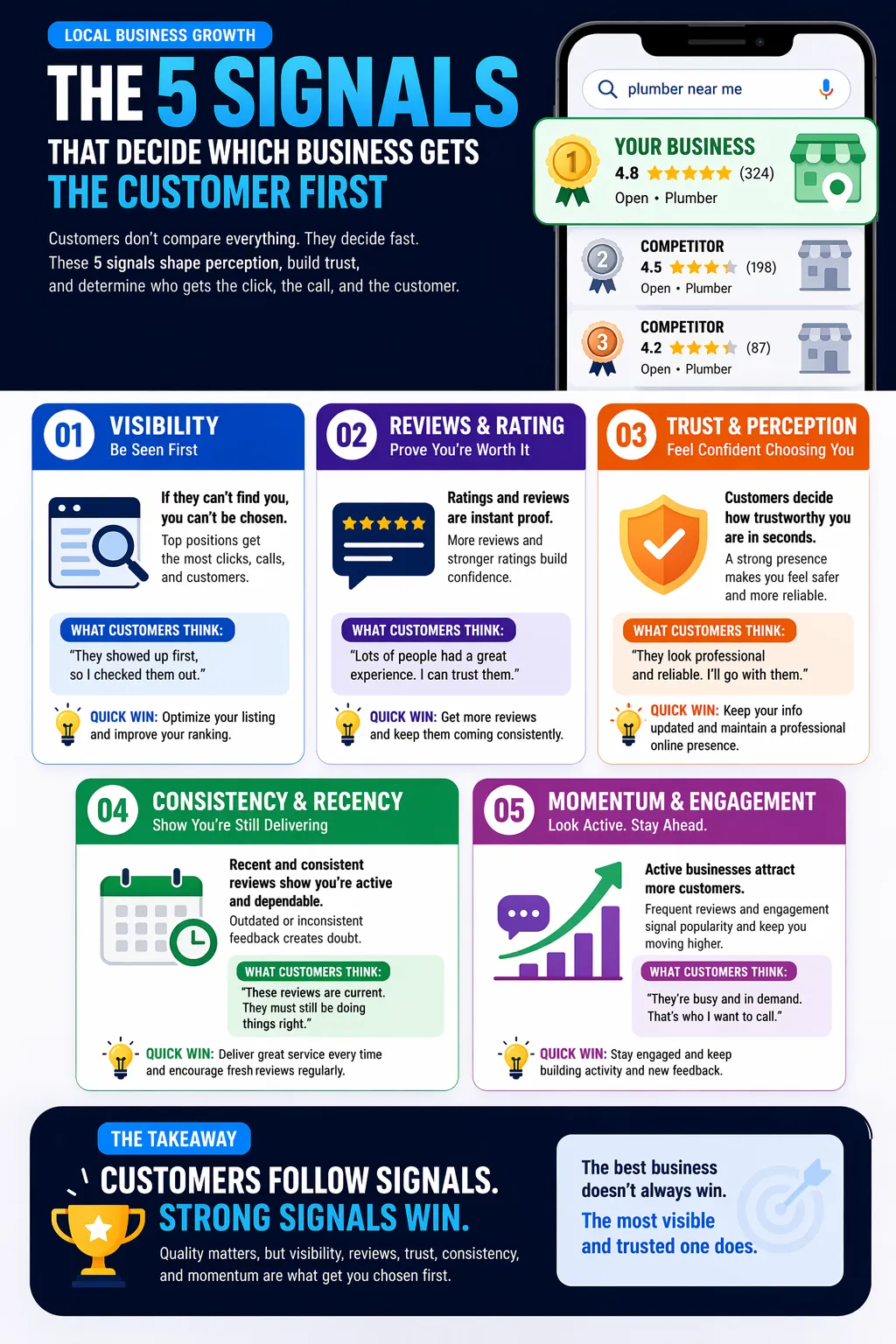
The 5 Signals That Decide Which Business Gets the Customer First
The 5 Signals That Decide Which Business Gets the Customer First
Most business owners believe customers choose based on quality, pricing, or experience.
While those things matter, they are not what determines who gets chosen first.
In reality, most customer decisions are made before a business is ever contacted.
They are made in search results, listings, and quick comparisons based on a handful of signals.
These signals shape perception, influence trust, and ultimately decide which business gets the click, the call, and the customer.
Understanding these signals is one of the most important steps in growing a local business.
Customers Decide Faster Than You Think
When someone searches for a service, they are not conducting deep research.
They are making fast decisions based on what they see immediately.
Most users:
Click one of the top results
Look at ratings and reviews
Choose the option that feels most reliable
They are not scrolling endlessly or comparing every option.
They are selecting quickly, often within seconds.
This means your ability to win a customer depends on how you appear in that moment.
Not just what you offer, but how you are positioned.
Signal #1: Visibility
The first and most important signal is visibility.
If your business does not appear where customers are searching, nothing else matters.
You cannot be chosen if you are not seen.
Visibility includes:
Your position in search results
Your presence on maps and listings
How often your business appears across platforms
Most customers interact with the top few results. Businesses outside of that range receive significantly less attention.
Even a small shift in position can have a large impact.
A move from position five to position three can dramatically increase traffic without changing anything else about your business.
Visibility is not just exposure. It is access to opportunity.
Signal #2: Reviews and Rating Strength
Once a customer sees your business, the next thing they evaluate is your reviews.
Reviews act as proof.
They answer the question: “Can I trust this business?”
But it is not just about having a high rating.
Customers look at:
The number of reviews
The overall rating
The tone and detail of feedback
A business with a large number of strong, consistent reviews will almost always outperform one with fewer or inconsistent reviews.
This is because volume creates confidence.
It signals that many people have chosen this business and had a positive experience.
Reviews are not just feedback. They are one of the most powerful decision-making tools customers use.
Signal #3: Trust and Perception
Trust is formed almost instantly.
Customers make assumptions based on what they see.
A business with:
High ratings
Consistent feedback
A professional presence
Is perceived as safer and more reliable.
This perception matters more than most people realize.
Even if two businesses offer the same service, the one that appears more trustworthy will get chosen more often.
Trust reduces hesitation.
It makes the decision feel easy.
And in fast decision environments, ease wins.
Signal #4: Consistency and Recency
Customers are not just looking at how good your business is. They are looking at how consistently good it is.
Consistency answers the question: “Will I have the same experience as everyone else?”
Recency answers the question: “Is this still true today?”
These signals are often overlooked, but they are critical.
A business with:
Steady, consistent ratings
Ongoing recent reviews
Will outperform a business with:
Fluctuating performance
Outdated feedback
Consistency builds reliability.
Recency builds relevance.
Together, they show that a business is actively delivering quality right now, not just in the past.
Signal #5: Momentum and Engagement
The final signal is momentum.
This reflects how active and engaged a business is in its market.
Momentum includes:
Frequency of new reviews
Ongoing customer interaction
Continuous activity over time
A business with strong momentum appears active, popular, and in demand.
Customers are naturally drawn to businesses that seem busy and engaged.
This creates a psychological effect.
If others are choosing this business, it must be a good choice.
Momentum reinforces trust and strengthens all the other signals.
How These Signals Work Together
Each of these signals is powerful on its own.
But their real impact comes from how they work together.
For example:
Visibility gets you seen
Reviews build credibility
Trust reduces hesitation
Consistency proves reliability
Momentum reinforces demand
When all five signals are strong, a business becomes the obvious choice.
Customers do not need to think deeply.
The decision feels clear and easy.
That is what top-ranked businesses achieve.
Why Some Businesses Struggle Despite Great Service
Many business owners provide excellent service but still struggle to attract customers.
This is usually because their signals are weak.
They may have:
Low visibility
Too few reviews
Inconsistent feedback
Little recent activity
Even if the actual service is high quality, customers cannot see or verify that.
And if they cannot see it, they cannot choose it.
This is one of the biggest disconnects in local business growth.
Quality alone is not enough.
It has to be visible and supported by strong signals.
Turning Signals Into Strategy
The good news is that these signals can be improved.
They are not fixed.
Businesses can actively strengthen their position by focusing on:
Increasing review volume consistently
Maintaining a reliable customer experience
Encouraging recent feedback
Improving visibility across search platforms
Staying active and engaged with customers
Small improvements in each area can lead to significant gains over time.
Because as these signals improve, everything else follows.
The Competitive Reality
In every local market, businesses are competing for the same customers.
And customers are making fast decisions based on limited information.
This means:
Small differences matter
Strong signals win
Weak signals get ignored
If your competitors have stronger visibility, better reviews, and more engagement, they will consistently capture more customers.
Not because they are better, but because they are better positioned.
Final Takeaway
Customers do not choose randomly.
They follow signals.
Visibility, reviews, trust, consistency, and momentum determine who gets chosen first.
If your business is not attracting the customers it should, the issue is likely not your service.
It is your signals.
The businesses that understand this and take action are the ones that grow.
Because in today’s market, the best business does not always win.
The most visible and trusted one does.
